
How to Vacuum Long Hair Without Clogging Your Vacuum

Quick Answer
To vacuum long hair, pick up large clumps first, use the right floor head, and vacuum with slow overlapping passes. Check the brush roll often and remove wrapped strands before they form a tight bundle. Good general household cleaning practices also help keep floors easier to maintain.
Quick Steps for Vacuuming Long Hair
- Collect large clumps: Pick up visible bunches before turning on the vacuum.
- Check the floor head: Make sure the brush roll is clean and able to rotate freely.
- Choose the right setting: Match the vacuum head and brush setting to carpet, rugs, or hard flooring.
- Move slowly: Use controlled, overlapping passes instead of rushing across the floor.
- Inspect the brush roll: Stop and remove wrapped hair whenever you notice buildup.
- Empty the vacuum: Keep the bin or bag from becoming overly full, especially after hair-heavy cleaning.
Long hair looks harmless on the floor, but it can be surprisingly hard on a vacuum. I’ve found that the real problem usually starts when strands wrap around the brush roll instead of entering the dust bin.
This guide explains how to vacuum long hair from carpet, rugs, and hard floors. I’ll also show you how I prevent tangles, clogs, and frustrating drops in pickup.
In This Guide
- What Is the Best Way to Vacuum Long Hair?
- How Should You Prepare Before Vacuuming Long Hair?
- How Do You Vacuum Long Hair From Different Floors?
- How Do You Stop Long Hair From Wrapping Around the Brush Roll?
- Which Vacuum Tools Work Best for Long Hair?
- How Often Should You Vacuum and Maintain the Machine?
- Frequently Asked Questions
What Is the Best Way to Vacuum Long Hair?
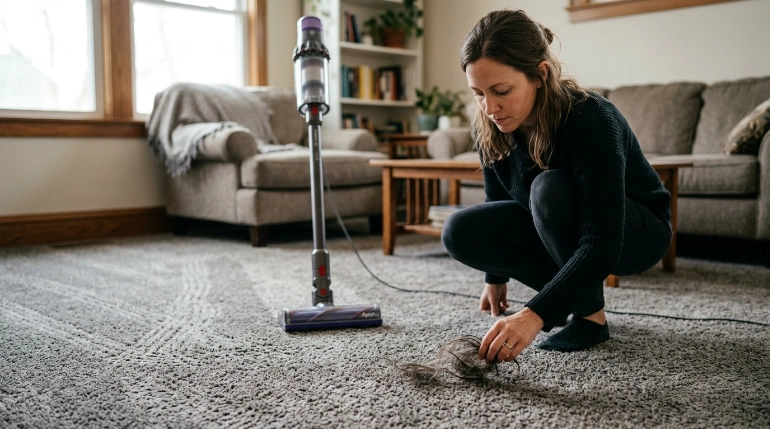
The best method is to remove large hair clumps first and then vacuum slowly. You want loose strands moving into the airflow instead of winding repeatedly around rotating parts.
Vacuuming long hair means removing loose strands while controlling the tangling they can cause inside the floor head. The brush roll is usually the part that needs the most attention.
Start with visible hair clumps
I don’t run the vacuum straight over a thick pile of hair anymore. Large bunches can enter the hose at once or wrap tightly around the roller.
Instead, I pick up obvious clumps by hand before starting. A rubber glove or simple floor squeegee can also gather scattered strands.
- Pick up thick bundles before vacuuming.
- Check corners where hair tends to collect.
- Look under furniture for hidden clumps.
- Remove string and thread at the same time.
Use slow overlapping passes
Long hair needs enough airflow to travel from the floor into the vacuum. Racing across the room gives the machine less opportunity to collect loose strands.
I make a slow forward pass and then pull the vacuum back over the same area. I overlap the next path slightly instead of leaving narrow strips between passes.
Change direction on carpet
Hair can settle between carpet fibers and become less visible. A second pass from another direction often exposes strands that the first pass missed.
This is especially useful around beds, dressing areas, bathrooms, and other places where long hair tends to collect.
Section Takeaway: Remove thick hair clumps first, then use slow overlapping passes. On carpet, change direction when loose strands remain trapped between fibers.
How Should You Prepare Before Vacuuming Long Hair?
A few minutes of preparation can prevent much more annoying cleanup later. I check the brush roll, bin, filter area, and floor setting before tackling a hair-heavy room.
Inspect the brush roll
Turn the vacuum off and unplug it before touching the rotating brush. For a cordless model, switch it off and remove the battery when the design allows it.
Look along the full width of the roller. Hair often collects near the ends as well as around the middle.
- Remove existing wrapped hair.
- Check the roller end caps.
- Look for string or thread.
- Confirm that the roller turns normally.
Starting with a clean brush gives incoming strands somewhere to go. Starting with an already tangled roller makes the next cleaning session harder.
Empty the dust bin or check the bag
Hair takes up a surprising amount of space because loose strands create an airy bundle. That bundle can make a small bin look full quickly.
I prefer starting hair-heavy cleaning with an empty bin. With a bagged vacuum, I check that the bag still has reasonable capacity.
Check the hose and airway
If suction already seems weak, don’t assume the floor needs more passes. Check for a blockage before continuing.
Common trouble spots include the floor-head inlet, short connecting hose, wand, and main hose. Always follow the manufacturer’s instructions before taking those areas apart.
How Do You Vacuum Long Hair From Different Floors?
The same vacuum setup isn’t ideal for every surface. Carpet usually benefits from agitation, while hard flooring often needs strong airflow without aggressive brushing.
Carpet
On carpet, use the normal carpet setting if the manufacturer recommends it. A powered brush roll can lift hair that has settled between carpet fibers.
Move slowly and watch the roller. If long strands are wrapping quickly, stop and clear them before continuing.
- Remove large visible clumps.
- Vacuum one section slowly.
- Make overlapping forward-and-back passes.
- Change direction where hair remains.
- Check the roller before moving to another room.
Hard floors
On wood, laminate, vinyl, or tile, I prefer a hard-floor head when one is available. Loose hair is easier to collect when the tool keeps it near the suction opening.
If your machine lets you switch the rotating brush off, that can also work well on compatible hard flooring. Follow the vacuum and flooring manufacturer’s guidance.
Area rugs
Rugs need more caution because construction varies. Check the care label before using a powered brush roll or strong suction.
Keep rotating brushes away from loose fringe. Fringe can wrap around a roller far faster than ordinary hair.
For delicate rugs, I use a suction-only tool when the care instructions permit vacuuming. It gives me more control near edges and decorative fibers.
Section Takeaway: Match the vacuum head to the surface. Carpet may benefit from agitation, while hard floors and delicate rugs often need a gentler approach.
How Do You Stop Long Hair From Wrapping Around the Brush Roll?
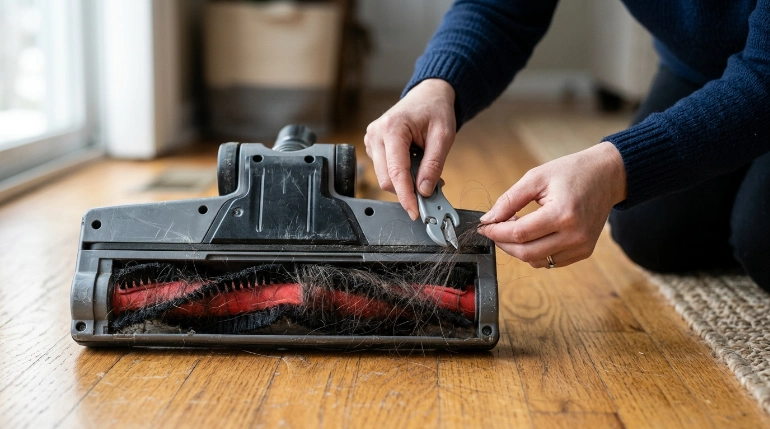
You may not eliminate every wrapped strand, but you can stop small tangles from becoming thick bands. Frequent inspection makes the biggest difference in my routine.
Clean the roller before it becomes packed
The mistake I used to make was waiting until pickup became poor. By that point, the hair was already wound tightly around the roller.
Now I check much sooner. Thin layers are easier to cut and pull away than a dense bundle.
Cut hair carefully along the roller
Always disconnect power first. Use the cleaning tool supplied with the vacuum when possible.
If the manufacturer permits it, carefully cut through wrapped hair without cutting the roller bristles or damaging the floor head. Pull the loosened strands away in small sections.
- Disconnect power: Never work around a powered brush roll.
- Expose the roller: Follow the manual if a cover must be removed.
- Cut only the hair: Keep sharp tools away from belts and wiring.
- Pull strands free: Remove loosened pieces instead of forcing the roller.
- Check both ends: Hair can hide near bearings and end caps.
Don’t assume an anti-tangle roller needs no maintenance
Some newer vacuums use combs or redesigned rollers intended to reduce hair wrapping. These features can be useful, but the floor head should still be inspected regularly.
Hair can migrate toward roller ends or combine with thread and lint. A quick check after cleaning prevents surprises.
Expert Alert: Stop using a vacuum that sparks, smells burnt, repeatedly trips a breaker, or has a damaged power cord. Electrical repairs should be handled by a qualified service professional.
Section Takeaway: Remove hair while the buildup is still small. Always disconnect power before touching, cutting, or cleaning around a rotating brush.
Which Vacuum Tools Work Best for Long Hair?
The best tool depends more on the surface than the vacuum’s shape. A useful setup gives hair a clear path into the airway while minimizing unnecessary wrapping.
| Surface or Area | Useful Tool | Brush Roll | Main Advantage | Watch For |
|---|---|---|---|---|
| Low- or medium-pile carpet | Powered floor head | Usually on | Lifts embedded hair from fibers | Hair wrapping around roller |
| Hard flooring | Hard-floor or soft roller head | Surface dependent | Collects loose strands efficiently | Scattering hair ahead of the head |
| Delicate rug | Suction-only tool | Off when appropriate | Gentler cleaning | Fringe and loose fibers |
| Edges and baseboards | Crevice tool | Not applicable | Reaches narrow hair traps | Blocked tool opening |
| Upholstery | Upholstery tool | Usually unnecessary | Controlled contact with fabric | Loose threads or delicate fabric |
Upright vacuums
Uprights can work well on carpet because many have a powered floor head. For long hair, easy brush-roll access matters because maintenance may be frequent.
Canister vacuums
A canister vacuum can be useful when you want different heads for different surfaces. A suction-only hard-floor tool also removes the brush-roll wrapping issue from those areas.
Stick vacuums
Stick vacuums are convenient for frequent cleanup. That convenience can help because collecting hair before it builds up reduces the amount handled in one session.
Robot vacuums
Robot vacuums can collect loose hair between deeper cleaning sessions. Their compact rollers, wheels, and side brushes still need inspection for wrapped strands.
If allergies are a concern, filtration and dust containment deserve attention too. AAFA provides information about certified vacuum cleaners and household products designed around allergen-related performance standards.
How Often Should You Vacuum and Maintain the Machine?
There isn’t one perfect schedule for every home. Hair shedding, household size, pets, floor type, and room use all affect how quickly strands build up.
In a home where long hair appears daily, short and frequent cleaning usually works better for me than waiting for a large weekly buildup.
Use the floor as your guide
Vacuum when visible strands begin collecting in traffic areas, corners, or around furniture. Don’t wait for the floor to look heavily covered.
AAFA suggests vacuuming once or twice a week as part of its broader advice for controlling indoor allergens. You can read its indoor allergen control guidance for more context.
Follow a simple maintenance routine
- After hair-heavy cleaning: Inspect the brush roll and floor-head opening.
- When pickup drops: Check the bin, bag, hose, wand, and airway.
- When the filter needs care: Follow the manufacturer’s cleaning or replacement schedule.
- Before storing: Remove visible tangles that could tighten during the next use.
Don’t wash a vacuum filter unless the manufacturer identifies it as washable. A damp filter can damage some machines or interfere with normal operation.
For a broader look at filtration and household particle control, the EPA indoor air quality resource explains how source control, ventilation, and filtration fit together.
Empty hair without creating another mess
Long hair can bridge across a dust bin instead of dropping out cleanly. Turn the vacuum off before emptying and follow its normal bin-release procedure.
People who are sensitive to household dust may prefer a more contained emptying method. The AAFA dust mite guidance also discusses vacuum filtration and reducing exposure to dust-related allergens.
Section Takeaway: Frequent light vacuuming keeps long hair from becoming a large maintenance problem. Brush-roll checks and proper filter care help keep the machine ready for the next cleaning.
Frequently Asked Questions
Can long hair damage a vacuum cleaner?
Long hair can cause problems when it wraps tightly around a brush roll, wheel, or rotating component. Regular removal helps prevent a small tangle from becoming a thick bundle that interferes with normal movement.
Should I sweep long hair before vacuuming?
You usually don’t need to sweep the whole room first. I simply pick up large clumps and let the vacuum handle loose individual strands.
Why does hair keep wrapping around my vacuum brush?
The brush roll rotates while contacting the floor, so long flexible strands can wind around it before suction pulls them into the airway. Frequent cleaning and a suitable floor-head design can reduce the buildup.
Can I vacuum long hair without a brush roll?
Yes, especially on hard floors. A suction-only floor tool can collect loose hair without giving strands a rotating roller to wrap around.
What should I do if long hair clogs the vacuum hose?
Turn the vacuum off and disconnect power before inspecting the airway. Follow the manufacturer’s instructions for removing the hose or blockage rather than pushing sharp objects blindly through it.
Are anti-tangle vacuums better for long hair?
An anti-tangle design can reduce how much hair winds around the roller. However, it doesn’t make the vacuum maintenance-free, so the floor head and roller ends still need regular checks.
Why does my vacuum lose suction after picking up hair?
Check the dust bin or bag, floor-head inlet, wand, hose, and filters. A bundle of hair can combine with lint and dust to restrict airflow even when the machine still sounds normal.
Final takeaway: The easiest way to vacuum long hair is to stop it from becoming a large tangle in the first place. Pick up thick clumps, vacuum slowly, use the right floor tool, and inspect the brush roll regularly.
Once I made brush-roll checks part of my normal cleaning routine, long hair became much less frustrating to manage. A minute of maintenance now can save a much longer untangling job later.
If long hair is a regular problem in your home, make these checks part of every vacuuming session. Your floors stay cleaner, and your vacuum is easier to maintain.