How to Vacuum Laminate Floors Without Scratching Them

Quick Answer
To vacuum laminate floors safely, use a hard-floor setting, suction-only head, or soft roller that will not grind grit against the surface. Remove loose stones first, keep the vacuum wheels clean, and work in slow overlapping passes; regularly removing hard dirt from laminate flooring also helps protect its surface.
Quick Steps
- 1. Check the floor: Pick up coins, stones, glass, and other objects that could scratch the laminate.
- 2. Inspect the vacuum: Remove grit, hair, or hardened debris from the wheels and floor head.
- 3. Choose hard-floor mode: Switch off an aggressive spinning brush when your vacuum allows it.
- 4. Start at the edges: Use a crevice tool along walls, cabinets, and plank edges.
- 5. Vacuum slowly: Make overlapping passes instead of repeatedly scrubbing the same spot.
- 6. Check problem areas: Finish around entrances, under furniture, and anywhere grit tends to collect.
One Rule I Never Ignore
- If the floor head sounds like it is dragging grit, stop immediately and inspect it before continuing.
Learning how to vacuum laminate floors looks simple until a tiny pebble gets trapped under a wheel or brush head. That is when an ordinary cleaning job can leave a visible mark.
I treat laminate as a hard floor that needs debris removed gently, not scrubbed aggressively. In this guide, I will show you the routine I use to collect dust, crumbs, pet hair, and gritty dirt while reducing the chance of scratches.
In This Guide
- What Is the Safest Way to Vacuum Laminate Floors?
- Which Vacuum and Settings Work Best on Laminate?
- How Should You Prepare Laminate Before Vacuuming?
- How Do You Vacuum Laminate Floors Step by Step?
- How Often Should You Vacuum Laminate, and What Should You Avoid?
- Frequently Asked Questions
- Final Takeaway
What Is the Safest Way to Vacuum Laminate Floors?
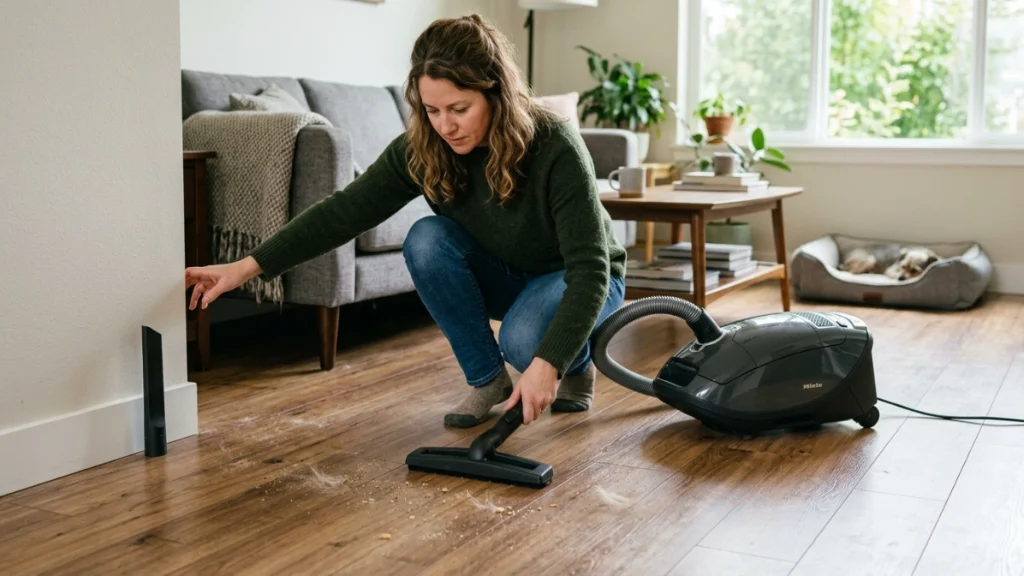
The safest method is to remove loose debris with suction while minimizing hard or aggressive contact with the floor. A clean hard-floor head, soft roller, or suction-only attachment usually gives you the control you need.
Definition: Vacuuming laminate floors means lifting loose dust and debris from the wear surface and joints without grinding that debris back across the flooring.
The key word is lifting. You want dirt to enter the vacuum instead of getting pushed around under a dirty wheel or stiff brush.
- Fine dust: Use normal suction and smooth, steady passes.
- Pet hair: A soft roller or hard-floor head can help collect strands without aggressive agitation.
- Sand and grit: Move carefully because hard particles can act like abrasives when dragged.
- Edges: Use a crevice tool instead of forcing the main floor head against trim.
- Large debris: Pick up sharp or oversized pieces by hand before vacuuming.
Consumer Reports notes that laminates have a plastic surface and recommends regular sweeping or vacuuming to remove hard dirt particles. That matches the habit I follow in my own cleaning routine: get gritty material off the floor before foot traffic grinds it around.
Why vacuum instead of only sweeping?
Sweeping can collect larger crumbs, but a vacuum also captures fine material from edges and low spots. It can be especially useful around baseboards, furniture legs, and plank joints.
Vacuuming can disturb fine indoor dust, though. The EPA notes that a vacuum with a HEPA filter can help keep some collected dust from escaping back into indoor air.
- For the floor: Prioritize smooth wheels and a nonaggressive head.
- For dust control: Keep filters, bags, bins, and seals in good condition.
- For allergies: Avoid letting a full bin or clogged filter weaken the vacuum’s performance.
You do not need maximum suction for every speck of dust. You need enough airflow to lift debris without making the floor head difficult to control.
Which Vacuum and Settings Work Best on Laminate?
A vacuum designed to clean bare or hard floors is usually the easiest choice for laminate. The important details are the floor head, brush action, wheels, and filtration rather than the vacuum’s shape alone.
As of 2026, canister, stick, upright, and robot vacuums are all available with hard-floor cleaning modes. Consumer Reports also includes laminate among the noncarpeted surfaces shoppers should consider when choosing a vacuum.
| Vacuum setup | Laminate suitability | Best use | What to check |
|---|---|---|---|
| Suction-only hard-floor head | Excellent | Dust, crumbs, grit | Clean underside and wheels |
| Soft roller head | Very good | Fine dust and pet hair | Remove trapped grit regularly |
| Brush roll switched off | Very good | Mixed-floor upright vacuum | Confirm the brush actually stops |
| Soft-bristle hard-floor brush | Good | Dust near edges and furniture | Check bristles for trapped particles |
| Aggressive carpet brush | Use cautiously | Only if manufacturer permits hard-floor use | Brush stiffness and contact |
Should the brush roll be on or off?
If your vacuum has a stiff, fast carpet brush, I prefer switching it off on laminate. That removes one source of unnecessary agitation.
A purpose-built soft roller is different. It is designed for hard-floor pickup, so it can remain useful when clean and used as intended.
- Use “hard floor” mode when your machine provides one.
- Turn off a stiff carpet brush when the vacuum permits it.
- Keep a soft roller clean so embedded grit does not stay in contact with the floor.
- Check the manual if your vacuum has unusual powered attachments.
Does a HEPA filter matter for laminate floors?
A HEPA filter does not make the laminate itself harder to scratch. Its role is filtration, not floor protection.
It can still be useful in a home-hygiene routine because vacuuming may disturb settled particles. The Asthma and Allergy Foundation of America recommends regular vacuuming and warns that poor-quality vacuums may put dust back into the air.
Filtration also depends on the entire machine. A dirty filter, leaking seal, overflowing bin, or poorly seated bag can undermine an otherwise good vacuum.
Section Takeaway: Choose the gentlest floor-contact system that still lifts debris effectively. Clean wheels, a suitable hard-floor head, and good filtration matter more than simply choosing the strongest vacuum.
How Should You Prepare Laminate Before Vacuuming?
Spend one minute inspecting both the room and your vacuum before you switch it on. This is one of the easiest ways to prevent avoidable scratches.
Pick up anything the vacuum should not drag
- Coins
- Small stones
- Broken glass
- Metal pieces
- Hard toy parts
- Large food pieces
- Wet or sticky debris
I pay special attention to entrances. Shoes can bring in sand and tiny stones that are easy to miss against patterned laminate.
Inspect the wheels and floor head
Turn the floor head over before cleaning. A tiny stone stuck beside a wheel worries me more than a little dust on the laminate.
- Spin each wheel: It should rotate freely without grinding.
- Check the roller: Remove hair, thread, and visible grit.
- Inspect hard edges: Look for cracked plastic or exposed parts.
- Check the opening: Remove anything that could scrape while you push.
If a wheel is jammed, fix that before continuing. Dragging a locked wheel through grit defeats the point of careful vacuuming.
Deal with moisture separately
A standard dry vacuum should not be used on liquid unless its manufacturer specifically designed it for wet pickup. Blot spills promptly instead of running an ordinary vacuum over them.
If water has entered laminate joints or you have ongoing swelling, leaking, or mold, cleaning alone will not correct the moisture source.
Expert Alert: If laminate has widespread water damage, persistent mold, or moisture from a plumbing problem, stop treating it as a routine cleaning issue and contact an appropriate flooring, mold-remediation, or plumbing professional.
How Do You Vacuum Laminate Floors Step by Step?
For most rooms, I work from the perimeter toward the open floor and finish near the exit. This keeps me from repeatedly walking over areas I just cleaned.
- Remove large and sharp debris. Pick up anything that could get trapped beneath the vacuum.
- Inspect the vacuum head and wheels. Remove hair, grit, and anything that feels rough.
- Select hard-floor mode. Use suction-only operation, a soft roller, or another laminate-friendly configuration.
- Vacuum the perimeter. Use a crevice tool around baseboards, cabinets, door tracks, and room edges.
- Clean under reachable furniture. Dust often collects where normal foot traffic cannot disturb it.
- Vacuum the open floor. Use smooth, overlapping passes instead of fast back-and-forth scrubbing.
- Make a second pass where needed. Focus on entrances, pet areas, dining spaces, and visible debris.
- Empty or maintain the vacuum afterward. Do not leave a packed bin or dirty head ready for your next cleaning session.
Start with the edges
The main vacuum head rarely reaches every millimeter beside baseboards. A crevice tool lets you collect that line of dust without repeatedly bumping the floor head against trim.
I also use it around refrigerator edges, cabinets, sofas, and door thresholds. These are common places for gritty debris to hide.
Use slow, overlapping passes
Speed is not the goal. Moving steadily gives airflow time to lift dirt rather than pushing it ahead of the nozzle.
You do not need to press down on the vacuum. Extra pressure may make the floor head harder to steer and can trap debris between surfaces.
- First pass: Cover the entire exposed floor methodically.
- Second pass: Target visible crumbs, pet hair, or dusty traffic lanes.
- Final check: Look toward a window or light source to spot remaining debris.
Should you vacuum with or against the laminate planks?
Either direction can collect surface debris when the vacuum is set correctly. I usually make my main pass along the plank direction because it feels controlled and makes it easy to follow a consistent path.
For debris sitting in a joint, a gentle crosswise pass or crevice tool can help. Do not scrub aggressively at the seam.
Pay attention to airborne dust too
The floor is only one part of home hygiene. Vacuuming can temporarily stir up fine particles, especially when equipment has weak filtration or when a room holds a lot of settled dust.
The National Institute of Environmental Health Sciences advises using a HEPA filter or double-layer microfilter bag when addressing dust-mite allergens. People who react strongly to dust may also need extra precautions while vacuuming.
- Keep the vacuum filter properly installed.
- Empty the bin before it becomes overfilled.
- Replace bags according to the vacuum manufacturer’s instructions.
- Clean reusable parts only when the manual says they are washable.
- Let washable filters dry completely before reinstalling them.
Section Takeaway: Good laminate vacuuming is controlled rather than aggressive. Remove dangerous debris first, clean the perimeter, make smooth passes, and keep the vacuum itself in good condition.
How Often Should You Vacuum Laminate, and What Should You Avoid?
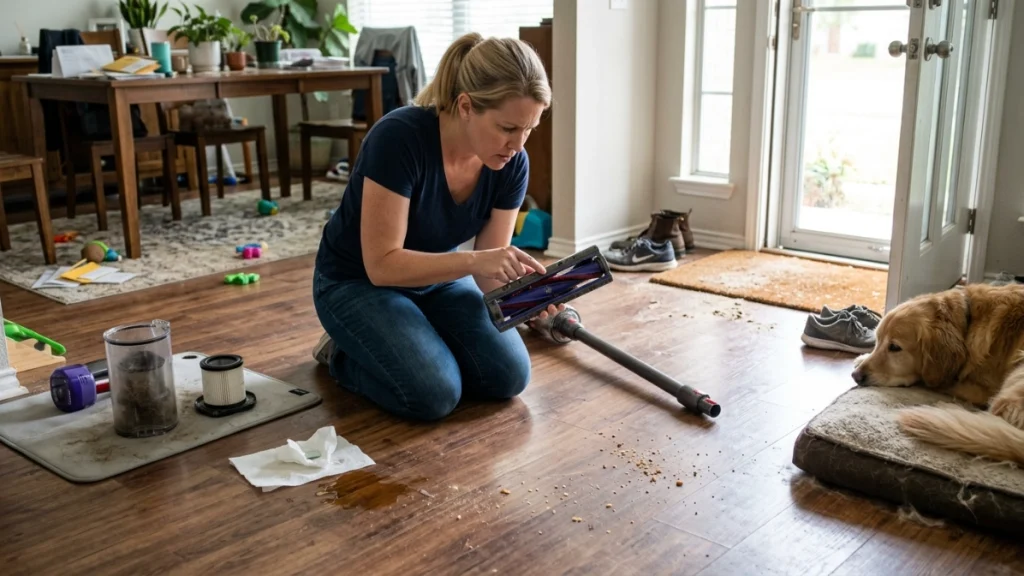
There is no single schedule that fits every household. The right frequency depends on foot traffic, pets, outdoor dirt, children, and how quickly visible debris returns.
For allergen control, AAFA recommends vacuuming once or twice a week as a general household measure. A busy laminate entryway may need spot cleaning more often because grit arrives there quickly.
| Household situation | Practical starting routine | Priority areas |
|---|---|---|
| Low-traffic home | About 1–2 full passes weekly | Entryways and kitchen edges |
| Children or frequent visitors | 2–4 times weekly as debris requires | Dining and traffic lanes |
| Shedding pets | Spot vacuum daily; full clean several times weekly if needed | Pet beds and favorite resting areas |
| Sandy or muddy entrance | Remove grit whenever visible | Doors, mats, and thresholds |
These are practical starting points, not flooring-manufacturer requirements. If your laminate maker gives a specific maintenance schedule, follow that guidance first.
Mistake 1: Using a dirty vacuum head
A clean-looking floor can still get scratched by debris caught under the machine. Check the underside when you hear scraping, grinding, or an unfamiliar clicking sound.
Mistake 2: Dragging a vacuum sideways
Most floor heads roll best forward and backward. Pulling a heavy machine sideways can make wheels skid instead of roll.
If you need to change direction, turn deliberately. Do not force a jammed head across the floor.
Mistake 3: Assuming every brush roll is laminate-safe
Carpet agitation and hard-floor cleaning are different jobs. A stiff powered brush that works well on carpet may be unnecessary on smooth laminate.
Use the hard-floor setting when available. If you are uncertain, check both the vacuum manual and flooring-care instructions.
Mistake 4: Vacuuming sharp objects
Do not deliberately vacuum glass, screws, pins, or other sharp material with a normal household machine. Pick those pieces up safely before cleaning the remaining small debris.
Mistake 5: Ignoring filters and airflow
Weak suction can make you repeat the same area again and again. Before blaming the floor head, inspect the bin, bag, hose, filter, and obvious blockages.
EPA guidance says frequent cleaning can help reduce dust buildup and notes that HEPA filtration can help keep some captured dust from escaping. That does not mean a HEPA label alone guarantees perfect indoor air.
Mistake 6: Treating wet messes like dry dust
Water, wet food, and sticky spills need a different response. Blot or clean them according to your flooring manufacturer’s instructions before normal vacuuming resumes.
Do not convert a dry vacuum into a wet vacuum by improvising. Moisture around an appliance that was not designed for liquid pickup creates an unnecessary equipment and electrical risk.
Section Takeaway: Vacuum laminate often enough that sand and grit do not accumulate, but focus just as much on technique. Clean equipment and gentle floor contact reduce avoidable wear.
Frequently Asked Questions
Can you use a regular vacuum cleaner on laminate floors?
Yes, if the vacuum has a suitable hard-floor setup and moves smoothly across the surface. Check the wheels and underside first, and switch off an aggressive carpet brush when the machine provides that option.
Should I turn off the brush roll on laminate?
Turn off a stiff carpet-style brush roll when your vacuum allows it and the manufacturer recommends doing so for hard floors. A purpose-built soft roller can usually remain active because it serves a different cleaning role.
Is a stick vacuum good for laminate floors?
A stick vacuum can work well when it has smooth wheels and a hard-floor or soft-roller head. The vacuum’s category matters less than how gently the floor head contacts the laminate and how well it picks up debris.
Can a robot vacuum clean laminate floors?
Many robot vacuums are designed to operate on hard floors, including laminate. Check the wheels, main brush, and side brush regularly because trapped grit can travel around the room beneath an otherwise convenient robot.
Is sweeping or vacuuming better for laminate?
Both can remove loose dirt, but vacuuming is useful for fine dust, pet hair, edges, and areas beneath furniture. Whichever method you choose, avoid dragging hard particles across the surface.
Can vacuuming scratch laminate flooring?
The vacuum itself should not automatically scratch laminate, but trapped stones, damaged wheels, exposed hard parts, or unsuitable aggressive attachments can create problems. Inspecting the machine before cleaning lowers those risks.
Do I need a HEPA vacuum for laminate floors?
No, HEPA filtration is not required simply because the floor is laminate. It can be useful when indoor dust and allergen control matter, because better filtration may reduce the amount of collected particulate matter that escapes through the vacuum exhaust.
Final Takeaway
Learning how to vacuum laminate floors comes down to one principle: remove dirt without turning that dirt into an abrasive. Clean wheels, the right hard-floor setting, and smooth passes make the biggest practical difference.
I would rather spend an extra minute checking the vacuum head than discover a stone trapped beneath it halfway through the room. Keep the machine clean, deal with grit early, and let suction do the work instead of pressure.
- Choose: A hard-floor head, suction-only tool, or clean soft roller.
- Check: Wheels, rollers, and the underside before vacuuming.
- Remove: Stones, glass, metal, and other dangerous debris first.
- Vacuum: Slowly with smooth, overlapping passes.
- Maintain: Filters, bins, bags, hoses, and attachments regularly.
- Respond: Clean gritty entry areas before dirt spreads through the room.
Once this becomes routine, laminate is straightforward to maintain. You get a cleaner floor without treating it like carpet or scrubbing it harder than necessary.