How to Use Vacuum Crevice Tools: A Complete Guide

Quick Answer
To use a vacuum crevice tool, attach the narrow nozzle firmly to the hose or wand, then guide it slowly through corners, edges, gaps, and seams. Keep the opening slightly above or lightly against the surface so airflow stays strong instead of sealing the nozzle shut. Consumer Reports’ vacuum attachment guidance also identifies crevice tools as the right attachment for tight, difficult-to-reach spaces.
Quick Steps
- 1. Connect it: Push the crevice tool securely onto your vacuum hose or wand.
- 2. Check the gap: Remove coins, large debris, liquids, or sharp objects before vacuuming.
- 3. Start slowly: Move the nozzle along the gap instead of making fast passes.
- 4. Keep airflow open: Avoid pressing the entire opening flat against fabric or carpet.
- 5. Change angles: Approach stubborn dirt from both directions when possible.
- 6. Clear the tool: Check the nozzle after cleaning narrow spaces where hair can collect.
My Best Tip
- Use slow overlapping passes. A crevice tool works best when you give suction time to pull debris from the gap.
I used to treat the crevice tool as the attachment that stayed clipped to the back of my vacuum. After testing it around sofas, baseboards, stairs, car seats, and cabinets, I learned that good technique makes a huge difference.
This guide explains how to use vacuum crevice tools safely and effectively for everyday home hygiene, including dust and allergen-prone areas.
In This Guide
- What Is a Vacuum Crevice Tool Used For?
- How Do You Use a Vacuum Crevice Tool Correctly?
- Where Should You Use a Crevice Tool?
- Crevice Tool vs. Other Vacuum Attachments: Which Should You Use?
- How Do You Get Better Suction Without Damaging Surfaces?
- Can a Crevice Tool Help With Dust, Allergens, and Mold Spores?
- Frequently Asked Questions
What Is a Vacuum Crevice Tool Used For?
A vacuum crevice tool is a long, narrow nozzle made for spaces that a normal floor head cannot reach. It concentrates your vacuum’s airflow into a smaller opening.
Definition: A vacuum crevice tool is a slim attachment designed to remove loose dirt, crumbs, hair, and dust from narrow gaps, edges, seams, and corners.
Most basic crevice tools have no moving brush or powered parts. Their advantage comes from their narrow shape and direct airflow.
You will find them with many upright, canister, stick, and handheld vacuums. Some cordless vacuums from brands such as Dyson and Shark also use combination or flexible versions.
- Edges: Use it where flooring meets baseboards or cabinets.
- Furniture gaps: Reach between sofa cushions and along seat seams.
- Car interiors: Clean beside seats, rails, consoles, and door pockets.
- Stairs: Reach the narrow line where the tread meets the riser.
- Appliances: Remove loose dust beside refrigerators and other accessible gaps.
- Window tracks: Pick up loose insects, dirt, and dry debris before wiping the track.
A crevice tool does not replace a dusting brush. Hard plastic can scrape delicate finishes, while a soft brush is usually safer for fragile surfaces.
It also does not make your vacuum’s filter better. HEPA filtration describes particle filtration, while CADR is an air-purifier performance measure and is not a crevice-tool rating.
How Do You Use a Vacuum Crevice Tool Correctly?
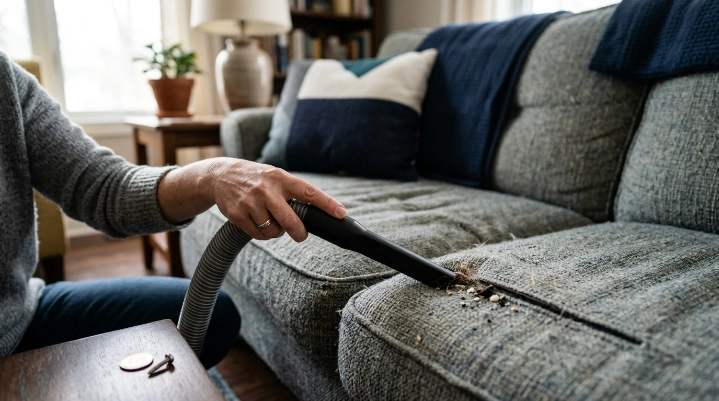
Attach the tool securely, inspect the area, then vacuum with slow passes while keeping the nozzle from sealing completely against the surface. That simple method handles most household gaps.
1. Inspect the area first
I always look into a tight gap before putting the nozzle inside. It takes only a few seconds and has saved me from vacuuming objects I wanted to keep.
- Pick up coins, screws, jewelry, and other useful items.
- Remove large pieces that could clog the nozzle.
- Do not use a standard dry vacuum on liquids.
- Avoid hot ash, embers, or anything still warm.
- Handle sharp glass or metal with a safer method instead of blindly vacuuming the gap.
2. Attach the crevice tool firmly
Push or click the attachment onto the hose, handle, or extension wand according to your vacuum’s design. A loose connection can leak air and make the tool feel weak.
If a universal attachment does not fit snugly, use the correct adapter. Don’t force mismatched plastic fittings together.
3. Start at one end of the gap
Place the opening near the dirt and move in one direction. I get better results from one controlled pass than several quick swipes.
- Begin at the cleanest accessible end.
- Move slowly toward the heavier debris.
- Overlap each pass slightly.
- Return from the opposite direction if dirt remains.
4. Let air enter the nozzle
More pressure does not always mean better cleaning. If you push the opening flat against upholstery, carpet, or another soft surface, you may restrict airflow.
Instead, lift the tip a fraction or change the angle. You’ll often hear the airflow become stronger again.
5. Use short strokes on seams
Couch seams and car-seat gaps can trap hair deeper than they first appear. Short forward-and-back movements help expose that material to the nozzle.
- Vacuum along the seam once.
- Change the nozzle angle.
- Vacuum the same seam in the opposite direction.
- Use a brush attachment first if hair is stuck to fabric.
6. Check the tool when suction drops
A narrow nozzle can clog faster than a wide floor head. Hair, paper, leaves, and compacted crumbs often jam near the tip.
Switch the vacuum off before inspecting the attachment. Remove the tool and clear the blockage according to the manufacturer’s instructions.
Section Takeaway: Attach the crevice tool securely, work slowly, and keep some airflow entering the opening. Changing direction is often more effective than simply pressing harder.
Where Should You Use a Crevice Tool?
Use a crevice tool anywhere loose debris collects inside a narrow, accessible space. I reach for mine most often around furniture, room edges, and the car.
Sofas and upholstered chairs
Remove loose cushions when the furniture allows it. Vacuum the exposed edges before working along each cushion seam.
- Between seat cushions
- Along the backrest seam
- Beside armrests
- Under removable cushions
If pet hair is woven into the fabric, use an upholstery or pet-hair tool first. The crevice nozzle is better for extracting what has fallen into the gap.
Baseboards and room edges
A floor head may leave a narrow dusty line beside walls. Running the crevice tool along that edge can remove material the wider head missed.
I prefer holding the nozzle at a slight angle instead of scraping it directly along painted trim. That reduces rubbing and keeps airflow open.
Car seats and consoles
This is one of the attachment’s best jobs. Seat rails, console edges, cup-holder surrounds, and the gaps between seats collect debris quickly.
- Move the seats forward and backward before cleaning.
- Vacuum visible debris before reaching underneath.
- Keep the nozzle away from exposed electrical connectors.
- Do not force the tool beneath trim panels.
Window tracks and cabinet corners
A crevice tool works well for loose, dry material in tracks and cabinet corners. Vacuum first, then wipe remaining grime with the cleaning method appropriate for the surface.
Sticky grease and dried spills need wiping rather than stronger suction.
Crevice Tool vs. Other Vacuum Attachments: Which Should You Use?

Choose the crevice tool for narrow openings, not simply because the area is small. Brushes and upholstery tools work better when the dirt sits on a surface rather than inside a gap.
| Attachment | Typical Design | Best Use | Main Limitation |
|---|---|---|---|
| Crevice tool | Long, narrow nozzle with a slim opening | Corners, seams, gaps, edges, car-seat spaces | Small cleaning path makes open surfaces slow |
| Dusting brush | Round or oval head with soft bristles | Shelves, vents, trim, delicate surfaces | Often too wide for deep gaps |
| Upholstery tool | Short, wider head | Sofa seats, fabric chairs, mattresses | Cannot reach narrow seams as deeply |
| Extension wand | Long rigid tube | High, low, or distant areas | Extends reach but normally needs another tool at its end |
For example, I use an upholstery head across a sofa cushion and switch to the crevice tool for the seam. That combination is faster than cleaning the entire cushion with one narrow nozzle.
As of 2026, the basic principle has not changed across most vacuum types: match the attachment shape to the surface and the location of the debris.
How Do You Get Better Suction Without Damaging Surfaces?
Good crevice-tool performance depends on clear airflow, clean filters, an unobstructed hose, and a proper attachment seal. Pushing harder is rarely the solution.
Check the vacuum before blaming the tool
If the crevice attachment suddenly feels weak everywhere, inspect the whole air path. The problem may sit inside the vacuum rather than inside the nozzle.
- Dust bin or bag: Empty or replace it when required by the manufacturer.
- Filter: Clean or replace washable and disposable filters as instructed.
- Hose: Check for hair, paper, or compacted debris.
- Connection: Make sure the attachment fits securely.
- Nozzle: Look through the opening for a local clog.
Protect delicate surfaces
Hard plastic can mark soft wood, glossy trim, leather, or fragile finishes. Don’t drag the nozzle aggressively over those materials.
Use a dusting brush when surface contact is the main job. Reserve the crevice nozzle for the actual gap.
Don’t force the nozzle into inaccessible spaces
If the attachment gets stuck, twisting harder can damage both the tool and the surrounding material. Stop and approach the area from another direction.
- Don’t pry apart furniture with the nozzle.
- Don’t push into electrical equipment.
- Don’t insert it into moving appliance parts.
- Unplug equipment before cleaning around accessible electrical areas when appropriate.
I also avoid using the longest possible hose-and-wand setup unless I need the reach. Extra connections can make the tool less convenient and harder to control.
Section Takeaway: Strong crevice-tool cleaning comes from clear airflow and good positioning, not force. Check the bin, filter, hose, nozzle, and connections whenever performance suddenly drops.
Can a Crevice Tool Help With Dust, Allergens, and Mold Spores?
A crevice tool can remove settled household dust from edges and gaps, including dust that may contain pollen, pet dander, dust-mite material, and other particles. It should be one part of a broader cleaning routine, not treated as an allergy or mold cure.
The EPA’s indoor particulate matter guidance notes that indoor dust can contain biological material and that activities such as vacuuming can also stir particles into the air.
Filtration still matters
The nozzle only determines where the vacuum collects debris. Your vacuum’s filter, seals, bag or bin, and overall design determine what happens to the collected air afterward.
The National Institute of Environmental Health Sciences includes vacuum filtration and damp dusting among its household dust-mite exposure strategies.
- Keep filters maintained according to the manual.
- Empty bagless bins carefully to limit dust clouds.
- Use a damp cloth for settled dust on suitable surfaces.
- Vacuum hidden edges routinely instead of waiting for heavy buildup.
If someone in the household is sensitive to airborne dust, avoid treating aggressive vacuuming as a medical intervention. Individual allergy and asthma needs should be discussed with an appropriate healthcare professional.
What about visible mold?
A crevice tool is not a mold-remediation device. Vacuuming visible active mold with an ordinary household vacuum may disturb contaminated material rather than solve the moisture problem.
The CDC’s mold guidance emphasizes removing mold while correcting the moisture source that allowed it to grow.
Expert Alert: If mold extends beyond a small, manageable area, keeps returning, involves significant water damage, or is inside walls or HVAC components, contact a qualified remediation professional instead of relying on a vacuum attachment.
For normal dry household dust, though, a crevice tool is useful because edges often get skipped by the regular floor head. I notice the biggest difference beside baseboards and under sofa cushions.
Frequently Asked Questions
Can I use a crevice tool on carpet?
Yes. Use it along carpet edges, stairs, furniture lines, and other places a floor head cannot reach. Avoid pressing the nozzle completely flat into thick carpet because that can restrict airflow and make the attachment harder to move.
Can I use a vacuum crevice tool on a sofa?
Yes. It works well between removable cushions and along narrow seams. Use an upholstery attachment on broad fabric areas, then switch to the crevice tool for gaps where crumbs, hair, and dust collect.
Why does my crevice tool lose suction?
Check for a clogged nozzle, blocked hose, full bin or bag, dirty filter, or loose connection. The nozzle may also be sealing against the surface, so change its angle and allow some air into the opening.
Can I use a crevice tool to clean my car?
Yes. It is especially useful beside seats, around seat rails, near the console, and inside accessible storage gaps. Remove larger objects first, and avoid forcing the nozzle around wiring or exposed electrical connectors.
Can a crevice tool remove pet hair?
It can collect loose pet hair from seams and gaps. Hair embedded in carpet or upholstery may need agitation from an upholstery brush, pet-hair tool, or powered attachment before the crevice nozzle can collect it efficiently.
Should the crevice tool touch the surface?
Light contact is usually fine on durable materials. Do not press it down so firmly that the opening becomes sealed, and avoid dragging hard plastic across delicate wood, paint, leather, or easily scratched finishes.
How often should I use a crevice tool?
There is no universal schedule. I use mine during normal vacuuming wherever dust gathers quickly, then give sofa gaps, baseboard edges, and other hidden areas a more careful pass when buildup becomes visible.
Final Takeaway: The best way to use a vacuum crevice tool is simple: inspect the gap, attach the nozzle securely, move slowly, keep airflow open, and change direction when debris stays behind. Use other attachments for broad or delicate surfaces, and keep your vacuum’s filter and air path maintained so the crevice tool can do its job.
Try using the crevice tool on one room’s baseboards, sofa seams, and furniture edges during your next vacuuming session. Those overlooked spaces often show why this small attachment deserves a permanent place in your cleaning routine.
“`