How to Use Upholstery Vacuum Attachments the Right Way

Quick Answer
To use an upholstery vacuum attachment, remove loose debris first, connect the upholstery tool securely, lower the suction if your vacuum allows it, and vacuum with slow overlapping passes. Work seams and cushion edges separately, and follow the fabric maker’s care instructions before cleaning delicate upholstery. Regular furniture vacuuming is also recommended in the EPA’s indoor dust guidance.
Quick Steps
- Check the fabric: Read the furniture care label and test delicate material gently.
- Remove cushions: Pick up coins, toys, and other objects before vacuuming.
- Attach the tool: Push the upholstery attachment firmly onto the hose or wand.
- Start gently: Use lower suction when cleaning loose, delicate, or thin fabric.
- Overlap passes: Move slowly across the fabric instead of quickly sweeping the nozzle around.
- Clean the edges: Switch to a crevice tool for seams, folds, and gaps between cushions.
One Important Tip
- Don’t press the attachment hard into soft cushions. Good airflow often cleans better than force.
I used to treat my upholstery tool as one of those vacuum accessories that stayed buried in a closet. Once I started using it correctly, I realized how much dust, crumbs, hair, and grit a normal floor head leaves behind on furniture.
This guide explains how to use upholstery vacuum attachments on sofas, chairs, cushions, mattresses, stairs, and car seats. I’ll also show you when a crevice tool, dusting brush, or powered mini tool works better.
In This Guide
- What Is an Upholstery Vacuum Attachment?
- How Do You Use an Upholstery Vacuum Attachment?
- Which Vacuum Attachment Should You Use on Upholstery?
- How Do You Vacuum Different Upholstery Safely?
- How Do You Handle Pet Hair, Dust, and Allergens?
- What Upholstery Vacuuming Mistakes Should You Avoid?
- Frequently Asked Questions
What Is an Upholstery Vacuum Attachment?
An upholstery vacuum attachment is a compact vacuum head designed to clean fabric-covered furniture and other soft surfaces. It usually has a wider opening than a crevice tool and may include short lint-catching strips, bristles, or an air-driven brush.
Definition: An upholstery vacuum tool spreads suction across a controlled area so you can remove surface debris from fabric without using a full-size floor head.
The attachment works well on sofas, upholstered chairs, fabric headboards, cushions, mattresses, carpeted stairs, and many vehicle seats. Its smaller size gives you much more control than a floor nozzle.
How is it different from a regular vacuum head?
A floor head is designed to cover large areas quickly. Many floor heads also have rotating brush rolls intended for carpet or hard flooring.
An upholstery head focuses suction on a smaller soft surface. That makes it easier to work around buttons, piping, curves, and cushion edges.
- Floor head: Best for carpets and large floor areas.
- Upholstery tool: Best for broad fabric surfaces.
- Crevice tool: Best for narrow gaps and seams.
- Dusting brush: Best for delicate surfaces and loose dust.
- Mini powered tool: Often useful for stubborn hair embedded in suitable durable fabric.
I find the upholstery attachment most useful when crumbs look gone but the sofa still feels dusty. Slow passes often pick up fine lint that fast back-and-forth movements miss.
Section Takeaway: The upholstery tool is the general-purpose attachment for fabric furniture, while smaller or powered attachments solve more specific cleaning problems.
How Do You Use an Upholstery Vacuum Attachment?
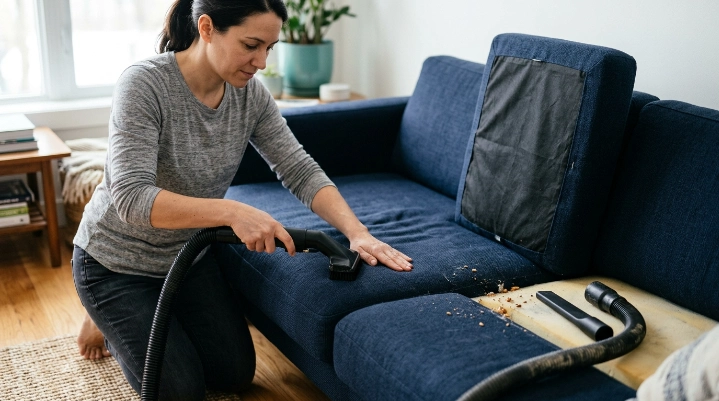
Start with low-risk areas, keep the nozzle moving, and let airflow do most of the work. You don’t need to grind the attachment into the fabric.
1. Check the furniture before you start
Look for loose threads, torn seams, decorative trim, buttons, or fragile fabric. Strong suction can catch damaged material and make an existing tear worse.
Remove coins, paper clips, small toys, and other hard objects. I also check under every cushion before turning the vacuum on.
2. Prepare the vacuum
- Empty an overly full dust bin or replace a full bag.
- Check the filter if airflow seems weaker than normal.
- Connect the hose or handheld unit.
- Push the upholstery attachment firmly into place.
- Select lower suction for delicate fabric if your machine has suction control.
A blocked hose can make you compensate by pressing harder. Fix the airflow problem instead.
3. Vacuum the main fabric surfaces
Start at the highest part of the furniture and work downward. This helps you collect anything that gets dislodged during cleaning.
- Place the upholstery head flat against the fabric.
- Pull it slowly across a short section.
- Overlap the next pass slightly.
- Change direction once if hair or lint remains.
- Repeat on the back, arms, seat, and cushions.
On my sofa, I get better results by making one slow pass from front to back, then another across the fabric. Quick scrubbing motions mostly move hair around.
4. Vacuum both sides of removable cushions
Lift each cushion rather than cleaning only what you can see. Dust and crumbs often collect along the bottom edges.
Hold lightweight cushions steady with one hand. Reduce suction if the fabric starts pulling tightly against the nozzle.
5. Switch tools for seams and gaps
An upholstery head cannot reach deeply between cushions. Use the crevice attachment for narrow channels, folds, piping, and the area where the sofa back meets the seat.
- Seat gaps: Insert the crevice tool gently and pull it toward you.
- Piping: Follow the edge rather than scraping across it.
- Buttons: Work around them without catching thread.
- Under cushions: Vacuum loose debris before replacing the cushions.
Take a minute to inspect the attachment when you’re finished. Hair wrapped around bristles or lint strips reduces its effectiveness next time.
Section Takeaway: Good upholstery vacuuming is slow and controlled. Clean broad surfaces first, then use a crevice tool for the places the upholstery head cannot reach.
Which Vacuum Attachment Should You Use on Upholstery?
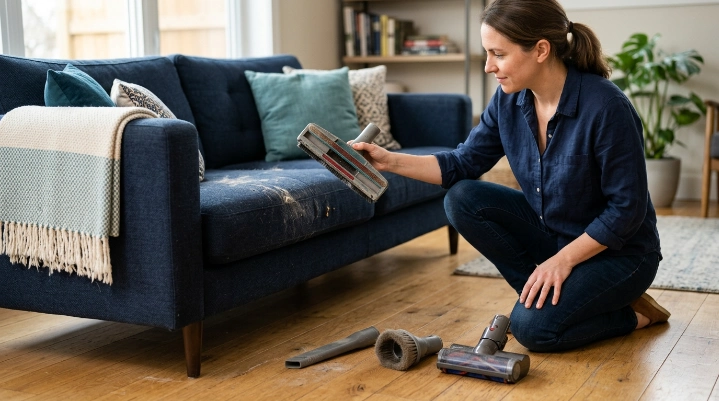
The standard upholstery head handles most routine furniture cleaning. A different attachment can work better when you’re dealing with narrow gaps, delicate material, or stubborn pet hair.
| Attachment | Contact Style | Best Use | Main Limitation |
|---|---|---|---|
| Upholstery tool | Wide, flat suction opening | Sofas, chairs, cushions, mattresses | Cannot reach deep gaps |
| Crevice tool | Narrow concentrated opening | Seams, cushion gaps, edges | Slow on broad surfaces |
| Dusting brush | Soft bristles around suction opening | Delicate surfaces and loose dust | Less effective on embedded hair |
| Mini powered tool | Small rotating brush | Pet hair on compatible durable upholstery | May be too aggressive for delicate fabric |
Upholstery tool vs. mini powered brush
A basic upholstery tool relies mainly on airflow. A mini powered attachment adds mechanical agitation through a rotating brush.
That agitation can help with hair trapped in a durable weave. I avoid using a powered brush automatically because loose threads and delicate textures need gentler treatment.
Does your attachment fit every vacuum?
No. Attachment fittings vary between vacuum models and manufacturers.
Check your manual or measure the connection before buying an accessory. A loose adapter can leak air and reduce useful suction at the nozzle.
Section Takeaway: Match the tool to the debris and surface. The upholstery head handles broad areas, while crevice and powered tools are better treated as specialized attachments.
How Do You Vacuum Different Upholstery Safely?
Not every fabric should be vacuumed with the same suction level or attachment. Start gently whenever you don’t know how a material will react.
Fabric sofas and chairs
Use the upholstery tool flat against the surface. Work slowly along the direction of the weave when it is easy to see.
Pay extra attention to armrests and the front edge of seat cushions. Those areas collect skin flakes, lint, crumbs, and pet hair quickly.
Delicate or loosely woven fabric
Lower the suction if possible and begin in an inconspicuous area. Stop if fibers, loops, fringe, or threads start pulling into the nozzle.
- Don’t drag the tool across loose decorative stitching.
- Avoid powered brushes on fragile material unless the manufacturer approves them.
- Keep the nozzle moving rather than holding strong suction in one spot.
Leather and faux leather
Leather doesn’t usually need an aggressive upholstery brush. I prefer a soft dusting attachment for surface dust and a crevice tool for gaps.
Avoid scratching the finish with hard plastic nozzle edges. Follow the furniture maker’s instructions for any cleaning or conditioning beyond dry vacuuming.
Mattresses
A clean upholstery attachment can remove loose dust, hair, and surface debris from a mattress. Vacuum the top, sides, piping, and accessible seams.
The National Institute of Environmental Health Sciences dust-mite guidance recommends HEPA filtration or a double-layer microfilter bag as part of dust-mite control measures.
Car seats
Use the broad upholstery head on seat centers and the crevice tool around rails, seams, buckles, and seat-back joints. Remove large debris first so it does not clog the narrow attachment.
Be especially careful around child-seat hardware and electrical controls. Vacuum around components rather than forcing a nozzle underneath them.
Section Takeaway: Fabric type matters as much as suction. Start with the gentlest tool that removes the debris, then increase agitation only when the upholstery can safely handle it.
How Do You Handle Pet Hair, Dust, and Allergens?
Vacuuming removes material that has settled on upholstery, but it can also disturb fine dust while you clean. Your vacuum’s filtration and your cleaning technique both matter.
The EPA recommends regular vacuuming of carpets and upholstered furniture and notes that cleaning can temporarily resuspend fine particles. Its indoor air guidance for health professionals discusses HEPA-filtered vacuuming when reducing dust exposure is a concern.
For stubborn pet hair
Start with normal suction before reaching for the most aggressive attachment. Hair that appears embedded sometimes lifts after slow passes made in opposite directions.
- Vacuum once with the upholstery tool.
- Turn the cushion if removable.
- Make a second pass across the first direction.
- Use a compatible mini powered tool only if hair remains.
- Remove wound hair from the brush after cleaning.
For dust-sensitive households
A HEPA filter is designed to capture fine particles in the vacuum’s filtration system, but the whole vacuum design also matters. A poorly sealed machine can still leak collected dust through other pathways.
As of 2026, I would check the manufacturer’s filtration and maintenance specifications rather than assuming every product labeled “HEPA” performs identically as a complete vacuum system.
- Check filters: Maintain them according to the vacuum maker’s instructions.
- Empty carefully: Dust can become airborne when you empty a bagless bin.
- Vacuum routinely: Don’t wait until furniture has a visible layer of dust.
- Work slowly: Controlled passes reduce the need for repeated aggressive cleaning.
The EPA also recommends weekly vacuuming of furniture as one way to reduce dust buildup and discusses HEPA-filtered vacuums in its dust-mite and asthma-trigger guidance.
What if you find mold on upholstery?
Don’t treat visible mold as ordinary vacuum dust. Vacuuming alone does not address the moisture source that allowed mold to grow.
Expert Alert: If upholstered furniture has substantial mold growth, repeated moisture damage, or contamination from major water damage, stop normal DIY vacuuming and get qualified advice. Review the CDC’s mold cleanup guidance before disturbing contaminated material.
Section Takeaway: Upholstery vacuuming helps control settled dust and debris, but filtration, careful bin emptying, routine cleaning, and moisture control are separate parts of good home hygiene.
What Upholstery Vacuuming Mistakes Should You Avoid?
Most poor results come from using too much force, moving too quickly, or choosing the wrong attachment. A few small changes can make upholstery cleaning much easier.
Pressing the nozzle too hard
Pushing harder can seal the opening against soft fabric and reduce airflow. It can also stretch loose upholstery.
Keep enough contact to lift debris without flattening the cushion deeply. I usually get better pickup by slowing down instead of adding pressure.
Using maximum suction on everything
Maximum suction isn’t automatically best. Thin fabric, loose covers, curtains, and delicate upholstery can pull tightly against the nozzle.
Use a suction-control valve or lower power setting when your vacuum provides one. Stop immediately if the material starts deforming.
Skipping seams and cushion gaps
A sofa can look clean while crumbs remain underneath every cushion. Those hidden channels are exactly where a crevice attachment earns its place.
- Remove cushions when possible.
- Vacuum the exposed platform.
- Follow seams with the crevice tool.
- Clean both sides of each cushion.
- Reassemble only after checking for missed debris.
Vacuuming wet upholstery with a dry vacuum
A normal household dry vacuum is not a wet extractor. Never suction liquid unless the manufacturer specifically says the machine is designed for wet pickup.
Likewise, an upholstery attachment for dry vacuuming is different from the spray-and-extraction tool supplied with some carpet cleaners.
Ignoring attachment maintenance
Lint, thread, and hair gradually collect around small tool openings. That buildup can reduce airflow and transfer dirt back onto light-colored furniture.
- Disconnect the vacuum before removing tangled material.
- Pull hair from bristles or lint-catching strips.
- Check the airway for clogs.
- Wipe hard plastic surfaces when needed.
- Let washable parts dry fully before reinstalling them.
Section Takeaway: Don’t compensate for poor airflow with more force. Correct suction, the right attachment, clean tools, and slow passes produce better results with less risk to your furniture.
Frequently Asked Questions
Can I use an upholstery vacuum attachment on a couch?
Yes. A standard upholstery attachment is designed for sofas, chairs, cushions, and similar fabric surfaces. Check for loose threads first, use moderate suction, and vacuum slowly. Use a crevice tool separately for seams and gaps.
How often should I vacuum upholstered furniture?
A practical routine is about once a week for frequently used furniture, especially in dusty homes or homes with pets. The EPA also recommends regular, including weekly, vacuuming of carpets and furniture as part of reducing indoor dust buildup.
Should I push down hard when using an upholstery attachment?
No. Keep the tool in contact with the fabric without crushing the cushion. Excessive pressure can restrict airflow and pull on delicate upholstery. Slow overlapping passes usually work better than pressing harder.
Can I use a crevice tool instead of an upholstery tool?
You can use a crevice tool for seams, corners, and narrow gaps, but it is inefficient for broad sofa surfaces. The upholstery head spreads suction across a wider area and normally gives more even coverage.
Is a brush attachment safe for every sofa?
No. Soft dusting brushes are gentle on many surfaces, while rotating powered brushes can be too aggressive for loose or delicate fabrics. Always inspect the upholstery and follow the furniture and vacuum manufacturers’ instructions.
What’s the best vacuum attachment for pet hair on furniture?
Start with the standard upholstery tool. If hair remains embedded and the fabric is durable, a compatible mini powered or pet-hair attachment may work better because it adds agitation. Avoid aggressive brushes on delicate weaves.
Can I vacuum wet upholstery with the same attachment?
Not with a standard dry vacuum. Wet extraction requires equipment specifically rated for liquid pickup. Using a dry-only household vacuum on wet upholstery can damage the machine and create an electrical hazard.
The main lesson is simple: match the attachment to the job, use enough suction without abusing the fabric, and slow your passes down. Once I started cleaning cushions, seams, and hidden gaps separately, my upholstery vacuum attachment became one of the tools I used most often.
For your next cleaning session, start with one sofa or chair and compare the dust you collect from the visible surfaces with what comes from underneath the cushions. That small test usually shows why the right attachment and technique matter.