
Dyson Air Purifier Vs HEPA: Essential Clean Air

Dyson air purifiers offer advanced features beyond standard HEPA filters, combining filtration with intelligent sensing and airflow. Understanding the Dyson air purifier vs HEPA distinction is crucial for choosing the best clean air solution for your home.
Breathing clean air at home is more important than ever, but navigating the world of air purifiers can feel overwhelming. You’ve likely heard the term “HEPA” thrown around constantly, and perhaps you’ve seen sleek, modern Dyson models that promise superior air quality. But what’s the real difference between a Dyson air purifier and a standard HEPA filter? This article will demystify the technology, break down the key distinctions, and help you make an informed decision for your home’s air. We’ll explore what makes Dyson stand out and where HEPA filters shine, so you can breathe easier knowing you’ve got the facts.
Understanding the Basics: HEPA Filters Explained
HEPA, which stands for High-Efficiency Particulate Air, is a standard for air filters. It means the filter can capture at least 99.97% of airborne particles that are 0.3 microns in size. These particles include things like dust mites, pollen, mold spores, and pet dander.
A HEPA filter works by forcing air through a fine mesh that traps harmful particles. Think of it like a very, very fine sieve for the air in your home. It’s a crucial technology for anyone with allergies or respiratory sensitivities.
This standard is widely recognized and used across many industries and by various air purifier brands. It’s a benchmark for effective particle removal, ensuring a significant reduction in common indoor air pollutants.
What Sets Dyson Air Purifiers Apart?
Dyson air purifiers go beyond just basic HEPA filtration. They integrate advanced sensing technology to detect and capture pollutants, as well as sophisticated airflow systems for powerful purification. Dyson machines often combine multiple functions, such as purifying, heating, and cooling, into a single unit.
Dyson’s approach is to continuously monitor your air quality in real-time. Their intelligent sensors identify different types of pollutants, from fine particles to gases, and then adapt the machine’s settings accordingly. This means your purifier is always working efficiently to maintain the cleanest possible air.
Many Dyson models also feature a sealed filtration system, ensuring that no dirty air bypasses the filter. This attention to detail in design maximizes the effectiveness of the HEPA and activated carbon layers within their purifiers.
Dyson Air Purifier vs HEPA: The Core Filtration Difference
The fundamental difference lies in the scope of filtration and the technology employed. While all Dyson air purifiers utilize HEPA filtration (often a combination of HEPA and activated carbon), they build upon this foundation with additional features. A standard HEPA air purifier typically focuses solely on mechanical filtration.
Dyson’s HEPA filters are designed to capture ultra-fine particles, similar to other HEPA standards. However, their machines often incorporate a layer of activated carbon, which is highly effective at capturing gases, odors, and VOCs (Volatile Organic Compounds). This dual-layer approach tackles a broader spectrum of indoor air pollutants.
Therefore, when considering Dyson air purifier vs HEPA, remember that Dyson purifiers contain HEPA filters, but they offer a more comprehensive purification system. It’s not an either/or situation; rather, Dyson integrates HEPA technology into a more advanced appliance.
Key Technologies in Dyson Air Purifiers
Dyson’s innovation shines through in several key technologies. Their Air Multiplier™ technology, for instance, projects purified air powerfully and evenly throughout the room. This ensures that clean air reaches every corner, rather than just circulating near the device.
Another significant feature is their range of intelligent sensors. These can detect PM2.5 (fine particulate matter), PM10 (larger particles), VOCs, and NO2 (nitrogen dioxide). This real-time monitoring allows the purifier to automatically adjust its fan speed and purification levels for optimal performance.
The Dyson Link app provides users with detailed reports on indoor and outdoor air quality, as well as remote control of their machine. This connectivity offers a level of insight and control that goes far beyond a typical HEPA-only purifier.
Comparing Filtration Efficiency: HEPA Standards
The HEPA standard itself is a robust measure of effectiveness. According to the U.S. Department of Energy, a true HEPA filter must remove at least 99.97% of particles 0.3 microns in diameter. This specific size is chosen because it’s considered the most penetrating particle size; smaller and larger particles are often trapped more easily.
Many air purifiers on the market claim to be “HEPA-like” or “HEPA-type,” which can be misleading. It’s essential to look for filters that are certified as “True HEPA” to ensure they meet the stringent 99.97% efficiency at 0.3 microns. Dyson machines typically meet or exceed these standards.
A study published in the Journal of Exposure Science & Environmental Epidemiology highlighted the significant impact of HEPA filtration in reducing indoor particulate matter, especially in homes with smokers or during wildfire events. This underscores the fundamental importance of HEPA technology.
Beyond Particles: Tackling Gases and Odors
While HEPA filters excel at capturing solid particles, they are generally not effective against gases, odors, and VOCs. These invisible pollutants can come from cooking, cleaning products, furniture off-gassing, and even outdoor pollution entering the home. This is where the activated carbon component in many Dyson purifiers becomes vital.
Activated carbon is a porous material that traps gas molecules through a process called adsorption. The vast surface area of the carbon effectively acts like a sponge for odors and harmful gases. Dyson units often use a substantial amount of activated carbon to maximize this gas-filtering capability.
For example, if you’re concerned about cooking smells or fumes from new paint, a Dyson with a strong activated carbon filter will be more effective than a HEPA-only unit. This comprehensive approach addresses a wider range of air quality concerns.
Airflow and Coverage: A Dyson Advantage
Effective air purification isn’t just about filtering; it’s also about distributing that clean air throughout your living space. Dyson’s Air Multiplier™ technology, as mentioned, is designed for powerful, consistent airflow. This helps to circulate air more effectively, drawing polluted air into the machine and projecting purified air back out.
This consistent airflow ensures that the entire room benefits from the purification process, not just the area immediately surrounding the purifier. This is particularly important in larger rooms or open-plan living spaces. The goal is to create a uniform environment of clean air.
A standard HEPA purifier might trap particles effectively but could struggle with circulation in a large room. Dyson’s focus on fluid dynamics and airflow projection is a key differentiator in ensuring comprehensive room coverage.
Convenience and Smart Features: The Dyson Experience
Dyson machines often come packed with smart features that enhance user experience and convenience. The ability to control the purifier remotely via the Dyson Link app is a significant advantage. You can check your air quality, adjust settings, and set schedules from anywhere.
Automatic mode is another highly appreciated feature, where the purifier intelligently adjusts its fan speed based on real-time air quality readings. This takes the guesswork out of operation and ensures your air is always being cleaned efficiently without manual intervention.
Many Dyson units also offer multi-functionality, serving as purifiers, heaters, and even fans. This consolidation of appliances can save space and offer year-round utility, making them a compelling choice for many households.
Understanding the Cost: Dyson vs. Standard HEPA
There’s no denying that Dyson air purifiers are a premium product with a higher price point compared to many standard HEPA air purifiers. This difference in cost is a direct reflection of the advanced technology, design, and multi-functionality that Dyson offers.
A basic HEPA air purifier can be purchased for under $100, while Dyson models typically range from $400 to $700 or more, depending on the specific model and its features. The ongoing cost of replacement filters should also be factored into the overall expense for any air purifier.
However, it’s important to consider the value proposition. If you’re looking for advanced sensing, gas filtration, smart features, and powerful, consistent airflow, the investment in a Dyson might be justified for its comprehensive performance.
Making Your Choice: Who is Each Best For?
When deciding between a Dyson air purifier and a standard HEPA unit, consider your specific needs and priorities. If your primary concern is capturing common allergens like pollen, dust, and pet dander, a good quality True HEPA air purifier can be highly effective and more budget-friendly.
However, if you are dealing with a wider range of pollutants, including odors, VOCs, and invisible gases, or if you value advanced smart features, real-time air quality monitoring, and powerful, widespread airflow, a Dyson air purifier offers a more comprehensive solution. For those who suffer from multiple sensitivities or live in areas with significant outdoor pollution, the Dyson’s advanced capabilities may be worth the investment.
Ultimately, the best choice depends on your individual health concerns, home environment, and budget. Both technologies play a vital role in improving indoor air quality.
Frequently Asked Questions
What is the main difference between a Dyson air purifier and a HEPA filter?
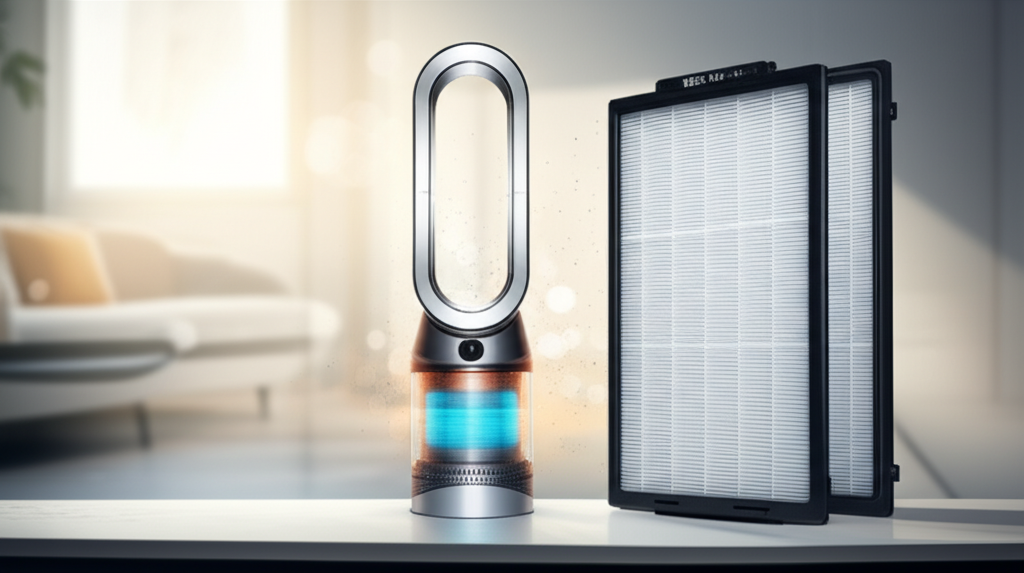
Dyson air purifiers use HEPA filters as part of their multi-stage purification system. The key difference is that Dyson units also incorporate advanced sensors, activated carbon for gas filtration, and unique airflow technologies for broader room coverage and intelligent operation.
Can a standard HEPA filter remove gases and odors?
No, standard HEPA filters are designed to capture particulate matter (like dust and pollen) but are not effective at removing gases, odors, or VOCs. For those, you need an activated carbon filter, which is often included in Dyson purifiers alongside HEPA filters.
Are Dyson air purifiers worth the extra cost?
For many users, the advanced features like real-time sensing, gas filtration, smart connectivity, and powerful airflow make Dyson air purifiers a worthwhile investment. If you have complex air quality concerns or desire a premium, integrated solution, the cost can be justified.
How often do I need to replace Dyson air purifier filters?
Dyson recommends replacing their HEPA and activated carbon filters typically once a year, depending on usage and environmental conditions. The Dyson Link app will usually notify you when it’s time for a replacement.
Are Dyson air purifiers effective for allergies?
Yes, Dyson air purifiers are very effective for allergies. They capture a high percentage of airborne allergens like dust, pollen, pet dander, and mold spores thanks to their HEPA filtration.
Can Dyson air purifiers cool a room?
Some Dyson models are designed as multi-functional machines that can purify air and also provide cooling or heating. These are often referred to as Dyson Pure Cool or Dyson Hot+Cool models.
Conclusion
In the Dyson air purifier vs HEPA debate, it’s clear that both play crucial roles in achieving essential clean air. HEPA filtration remains the gold standard for capturing fine particles, forming the backbone of effective air purification. Dyson takes this fundamental technology and elevates it by integrating intelligent sensing, robust activated carbon filtration for gases and odors, and superior airflow dynamics.
While a standard HEPA filter provides excellent particle capture, Dyson offers a more holistic and intelligent approach to indoor air quality management. Whether you need a simple, effective particle remover or a sophisticated, all-encompassing air purification system, understanding these distinctions empowers you to make the best choice for your home and your well-being. Breathe cleaner, live better!
For more insights into creating a healthier home environment, explore our guides on optimizing home ventilation and understanding indoor air pollutants.
