Dyson Air Purifier Comparison Chart: Essential Guide

Navigating the world of air purifiers can be overwhelming, but this Dyson air purifier comparison chart is your essential guide. We break down the key features, technologies, and models to help you find the perfect Dyson air purifier for your home, ensuring cleaner, healthier air with confidence.
Breathing clean air at home is more than just a luxury; it’s a fundamental aspect of well-being. Yet, with a multitude of air pollutants lurking unseen, from dust and pollen to pet dander and VOCs, maintaining optimal indoor air quality can feel like a constant battle. Dyson, a brand synonymous with innovation, offers a range of advanced air purifiers designed to tackle these challenges. But with various models boasting different features, choosing the right one can be a daunting task. This guide is here to simplify that decision, providing a clear Dyson air purifier comparison chart to illuminate your path to healthier air.
Why Invest in a Dyson Air Purifier?
Dyson air purifiers are more than just stylish appliances; they represent a significant investment in your family’s health. These devices go beyond basic filtration, actively sensing and capturing microscopic particles while projecting purified air into every corner of your room. Their multi-functional designs also offer cooling or heating capabilities, providing year-round comfort and air quality management. By choosing Dyson, you’re opting for cutting-edge technology designed to create a healthier living environment.
Dyson air purifiers are engineered to provide superior air purification, offering advanced filtration and intelligent sensing technology. They are designed to tackle a wide range of airborne pollutants, ensuring a healthier indoor environment for you and your loved ones.
Understanding Dyson’s Core Air Purification Technologies
At the heart of every Dyson air purifier lies a sophisticated system designed for comprehensive air cleaning. These machines typically combine a sealed HEPA filtration system with an activated carbon layer to capture an impressive array of pollutants. The sealed system is crucial, preventing dirty air from bypassing the filter and re-entering your room, a common issue with less advanced purifiers.
Dyson’s purifiers employ a powerful combination of HEPA and activated carbon filters to capture pollutants. This dual-action approach effectively traps microscopic particles like allergens and gases, ensuring cleaner air.
The Power of HEPA Filtration
High-Efficiency Particulate Air (HEPA) filters are the gold standard for air purification, and Dyson utilizes them extensively. A true HEPA filter is certified to capture at least 99.97% of particles as small as 0.3 microns. This includes common allergens like pollen, dust mites, mold spores, and pet dander, which can trigger respiratory issues and allergies.
HEPA filters are essential for trapping tiny particles like allergens and dust. Dyson’s use of HEPA filtration ensures that even the smallest airborne irritants are captured, leading to noticeably cleaner air.
Activated Carbon for Odor and Gas Removal
While HEPA filters excel at capturing solid particles, activated carbon filters are vital for addressing gases, odors, and volatile organic compounds (VOCs). Dyson’s activated carbon layer is treated to maximize its surface area, allowing it to adsorb harmful gases like formaldehyde, benzene, and nitrogen dioxide, as well as unpleasant household odors from cooking or pets.
Activated carbon filters work by adsorbing gases and odors. Dyson’s inclusion of this layer tackles invisible chemical pollutants and unpleasant smells, further enhancing air quality.
Dyson’s Air Multiplier™ Technology
Beyond filtration, Dyson purifiers are renowned for their Air Multiplier™ technology, originally developed for their bladeless fans. This technology amplifies the air, allowing purified air to be circulated throughout the entire room efficiently. It ensures that clean air reaches all corners, rather than just pooling around the unit, creating a more consistent and healthier environment.
Dyson’s Air Multiplier™ technology ensures even distribution of purified air. This innovative system circulates clean air effectively throughout your space, reaching every corner for comprehensive air quality.
Key Dyson Air Purifier Models: A Comparison
Dyson offers several distinct lines of air purifiers, each with unique features and benefits. Understanding these differences is key to selecting the model that best suits your needs and living space. We’ll delve into some of their most popular series.
Here’s a look at some of Dyson’s prominent air purifier series and what makes them stand out. Each model offers advanced purification, but they differ in additional functionalities and coverage areas.
Dyson Purifier Cool™ Series
The Dyson Purifier Cool™ series focuses primarily on air purification and cooling. These models are ideal for warmer climates or for those who experience bothersome summer heat. They feature the core HEPA and activated carbon filtration, combined with Dyson’s bladeless fan technology for a powerful cooling effect.
The Purifier Cool™ series excels at both purifying and cooling your air. It’s a great option for maintaining comfortable temperatures while ensuring excellent air quality during warmer months.
Dyson Purifier Hot+Cool™ Series
Building upon the Cool™ series, the Dyson Purifier Hot+Cool™ models offer year-round functionality. They provide powerful air purification and cooling, but also include a backward airflow mode and a safe, powerful heating element. This makes them a versatile choice for managing indoor climate and air quality throughout all seasons.
These versatile units provide purification, cooling, and heating. The Hot+Cool™ series is perfect for those seeking a single solution for year-round comfort and optimal air quality.
Dyson Purifier Formaldehyde Series
For those particularly concerned about indoor air quality, the Dyson Purifier Formaldehyde series offers an advanced solution. These models not only capture particles and gases with their HEPA and activated carbon filters but also feature a solid-state formaldehyde sensor. This unique sensor precisely detects and destroys formaldehyde molecules, which can off-gas from furniture and building materials, at the molecular level.
The Formaldehyde series offers specialized protection against harmful gases. Its advanced sensor targets and destroys formaldehyde, ensuring the purest possible air for your home.
Dyson Purifier Humidify+Cool™ Series
The Dyson Purifier Humidify+Cool™ series addresses a crucial aspect of indoor air quality: humidity. In dry environments, low humidity can exacerbate respiratory issues and dry out skin. This series purifies the air, provides cooling, and uses a UV-C treated water system to hygienically humidify your room, helping to maintain optimal comfort levels.
This series tackles purification, cooling, and humidity control. It’s an excellent choice for dry climates or when you need to manage both air purity and comfortable moisture levels.
Dyson Air Purifier Comparison Chart: Key Features at a Glance
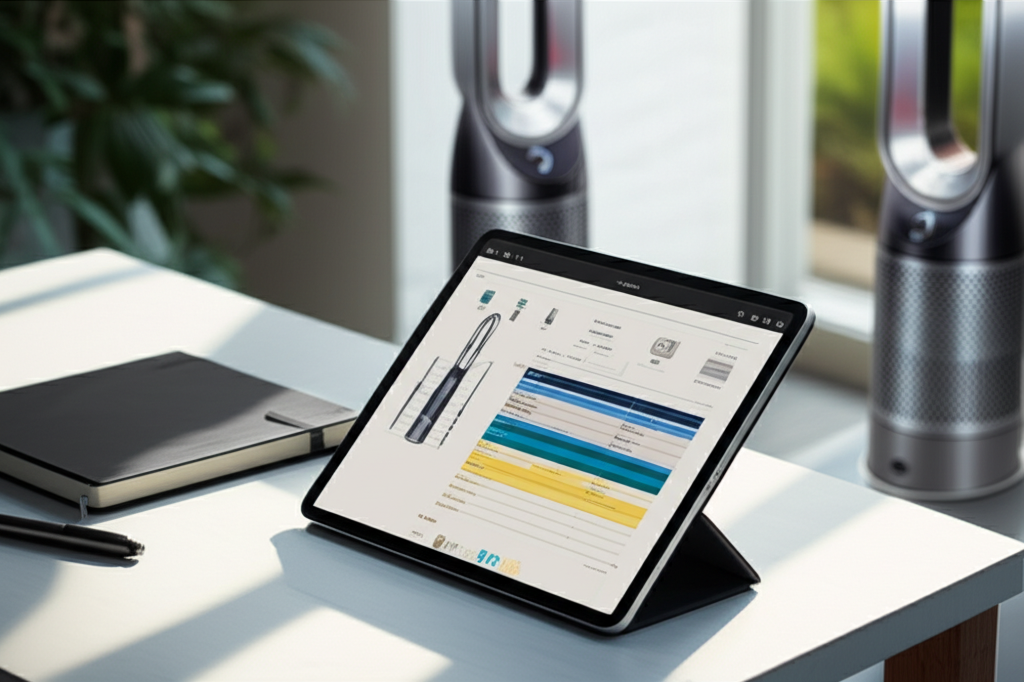
To help you make an informed decision, here is a Dyson air purifier comparison chart highlighting the key differences between popular models. This table focuses on core functionalities and advanced features.
| Feature | Dyson Purifier Cool™ (e.g., TP07) | Dyson Purifier Hot+Cool™ (e.g., HP07) | Dyson Purifier Formaldehyde (e.g., HP09) | Dyson Purifier Humidify+Cool™ (e.g., PH04) |
| :——————- | :——————————– | :———————————— | :————————————— | :—————————————– |
| Air Purification | HEPA + Activated Carbon | HEPA + Activated Carbon | HEPA + Activated Carbon + Formaldehyde Sensor | HEPA + Activated Carbon |
| Cooling | Yes | Yes | Yes | Yes |
| Heating | No | Yes | Yes | No |
| Humidification | No | No | No | Yes |
| Formaldehyde Sensor | No | No | Yes | No |
| Smart Connectivity | Yes (Dyson Link App) | Yes (Dyson Link App) | Yes (Dyson Link App) | Yes (Dyson Link App) |
| Display | LCD | LCD | LCD | LCD |
| Coverage Area | Varies by model | Varies by model | Varies by model | Varies by model |
This comparison chart provides a snapshot of what each Dyson series offers. Remember to check specific model numbers for exact specifications, as features can vary within a series.
Decoding Dyson’s Smart Features and Connectivity
In today’s connected world, smart home integration is a significant consideration. Dyson air purifiers are designed with this in mind, offering robust connectivity through the Dyson Link app. This app allows you to monitor indoor and outdoor air quality in real-time, control your purifier remotely, and set schedules.
The Dyson Link app provides seamless control and real-time air quality monitoring. You can manage your purifier from anywhere, ensuring optimal air conditions are always maintained.
Real-time Air Quality Monitoring
One of the most compelling aspects of Dyson’s smart purifiers is their ability to provide detailed air quality reports. Using integrated sensors, they continuously monitor particulate matter (PM2.5, PM10), VOCs, and temperature/humidity levels. This data is accessible via the Dyson Link app, giving you a comprehensive understanding of your indoor environment.
Continuous sensing provides detailed insights into your home’s air quality. The app displays real-time data on pollutants, helping you understand what you’re breathing.
Remote Control and Scheduling
The Dyson Link app empowers you to control your air purifier from your smartphone or tablet, whether you’re at home or away. You can adjust fan speed, switch modes, and even set custom schedules to ensure your purifier operates efficiently when you need it most. This convenience ensures you always return to a clean and comfortable environment.
Remote control via the Dyson Link app offers unparalleled convenience. Schedule purification cycles or adjust settings on the go to optimize your home’s air.
Which Dyson Air Purifier is Right for You?
Choosing the perfect Dyson air purifier depends on your specific needs, room size, and budget. Consider the primary issues you want to address – allergies, odors, heating, cooling, or humidity – and let that guide your selection.
Your ideal Dyson air purifier depends on your priorities. Assess your main concerns, such as allergies, odors, temperature control, or humidity, to make the best choice.
For Allergy Sufferers
If allergies are your primary concern, any Dyson air purifier with a HEPA filter will offer significant relief. However, models like the Purifier Cool™ or Hot+Cool™ are excellent starting points, providing robust particle capture. For those with extreme sensitivities, the Formaldehyde series might offer an added layer of reassurance due to its specialized sensor.
For allergy sufferers, models with advanced HEPA filtration are key. These units effectively capture microscopic allergens, providing much-needed relief from symptoms.
For Year-Round Comfort
If you desire a single solution for all seasons, the Dyson Purifier Hot+Cool™ series is an excellent choice. It provides purification, cooling, and heating, making it a versatile appliance that adapts to your comfort needs throughout the year.
Year-round comfort is best achieved with models offering multiple functionalities. The Hot+Cool™ series provides purification, cooling, and heating for consistent comfort in any season.
For Ultimate Air Purity
For those who demand the absolute highest standard of air purity, the Dyson Purifier Formaldehyde series is hard to beat. Its unique ability to detect and destroy formaldehyde molecules sets it apart, offering a level of protection against invisible chemical pollutants that few other purifiers can match.
The Formaldehyde series offers the highest level of air purity. Its specialized sensor destroys formaldehyde molecules, ensuring your air is exceptionally clean and healthy.
For Humidified Air
In dry climates or during winter months, maintaining optimal humidity is crucial. The Dyson Purifier Humidify+Cool™ series is the perfect solution, combining powerful air purification with hygienic humidification to create a balanced and comfortable indoor environment.
Maintain ideal humidity levels alongside purified air with the Humidify+Cool™ series. It’s the ultimate solution for dry environments needing both clean and comfortably moist air.
Maintaining Your Dyson Air Purifier
To ensure your Dyson air purifier continues to perform optimally, regular maintenance is essential. This primarily involves replacing the filters and keeping the unit clean. Dyson recommends replacing filters annually, depending on usage and air quality levels, to maintain their effectiveness.
Regular filter replacement and cleaning are crucial for peak performance. Follow Dyson’s guidelines to ensure your purifier always operates at its best.
Filter Replacement Guide
Your Dyson Link app will typically notify you when it’s time to replace your filters. The process is usually straightforward, with filters designed for easy removal and replacement. Always use genuine Dyson replacement filters to ensure compatibility and maintain the sealed filtration system’s integrity.
The Dyson Link app will alert you when filter replacement is needed. Using genuine Dyson filters guarantees optimal performance and maintains the sealed system.
Cleaning Your Dyson Unit
Beyond filter changes, occasional cleaning of the exterior and fan aperture will keep your Dyson air purifier looking its best. A soft, damp cloth is usually sufficient for cleaning the unit. Avoid using abrasive cleaners or harsh chemicals, as they can damage the appliance.
Regularly clean the exterior of your Dyson unit with a soft cloth. This simple maintenance keeps your appliance looking pristine and functioning smoothly.
Frequently Asked Questions About Dyson Air Purifiers
What is the main difference between Dyson Cool and Hot+Cool models?
The primary difference is that Dyson Hot+Cool models offer both heating and cooling functions, while the Cool models only provide cooling alongside air purification.
How often do I need to replace the filters in a Dyson air purifier?
Dyson recommends replacing filters approximately every 12 months, depending on usage and air quality. Your Dyson Link app will provide specific notifications.
Can Dyson air purifiers help with pet allergies?
Yes, Dyson air purifiers are highly effective at capturing pet dander, fur, and associated allergens thanks to their HEPA filtration system.
Are Dyson air purifiers noisy?
Dyson purifiers are designed to be relatively quiet, especially on lower settings. They feature a diffused airflow mode to reduce noise when set to oscillate.
Do Dyson air purifiers remove viruses?
Yes, the HEPA filtration in Dyson air purifiers can capture airborne viruses, which are often smaller than 0.3 microns.
Is the Dyson Purifier Formaldehyde series worth the extra cost?
If you are concerned about formaldehyde off-gassing from furniture or building materials, the Formaldehyde series offers specialized protection that may justify the higher price point for peace of mind.
What is the coverage area of a Dyson air purifier?
Coverage area varies by model. Dyson purifiers are designed to purify an entire room effectively, with specific square footage recommendations available for each model.
Conclusion: Your Path to Healthier Air
Choosing the right Dyson air purifier is a significant step towards creating a healthier living environment. By understanding the core technologies, comparing the available models, and considering your unique needs, you can confidently select a device that offers both exceptional performance and intelligent design. Whether you prioritize cooling, heating, humidification, or specialized formaldehyde removal, this Dyson air purifier comparison chart and guide have equipped you with the knowledge to make the best choice. Invest in your well-being and breathe easier knowing you’ve chosen a Dyson for superior air quality.
Explore more about maintaining a healthy home environment by visiting our blog.