
Air Purifier vs Dehumidifier vs Humidifier: Which Do You Need?

Quick answer
An air purifier removes particles like dust, pollen, pet dander and smoke. A dehumidifier pulls excess moisture out of the air to stop mold and musty smells. A humidifier adds moisture when the air is too dry. Check your humidity with a cheap hygrometer first: above 50% points to a dehumidifier, below 30% points to a humidifier, and allergy or dust problems point to an air purifier. The EPA recommends keeping indoor humidity between 30% and 50%.
Dust that settles again a day after you clean, a musty basement, a scratchy throat every winter morning: these are three different air problems, and each needs a different machine. Buying the wrong one wastes money and can even make things worse. A humidifier in a damp home, for example, feeds mold. This guide explains what each device does, how to tell which problem you have, and when it makes sense to run two of them together.
Air purifier vs dehumidifier vs humidifier at a glance
| Air purifier | Dehumidifier | Humidifier | |
|---|---|---|---|
| What it does | Filters particles and odors out of the air | Removes moisture from the air | Adds moisture to the air |
| Problems it solves | Allergies, dust, pet dander, smoke, cooking smells | Mold, mildew, condensation, musty odors, dust mites | Dry skin, dry sinuses, static shocks, cracking wood |
| How it works | Fan pulls air through a HEPA filter (plus carbon for odors) | Cold coils condense water vapor into a tank or drain | Evaporation, ultrasonic mist or steam |
| Changes humidity? | No | Lowers it | Raises it |
| Best season / place | Year-round, bedrooms and living rooms | Humid summers, basements, bathrooms, laundry rooms | Winter heating season, dry climates, bedrooms |
| Main upkeep | Replace filters (often every 6–12 months) | Empty the tank, wash the filter | Empty, clean and dry often; use distilled water |
| Key spec to compare | CADR and room size | Pints per day | Output and tank size |
Which one do you need? Match your symptom
Start with a hygrometer (a small humidity meter, usually under $15). Humidity readings settle most of the confusion in a day or two.
| What you notice | Likely cause | Device to use |
|---|---|---|
| Sneezing, itchy eyes, visible dust, pet hair and dander | Airborne particles | Air purifier |
| Smoke or cooking smells that linger | Particles and odors | Air purifier with a carbon filter (and better ventilation) |
| Musty smell, damp walls, water on windows, mold spots | Humidity above 50–60% | Dehumidifier (and fix the water source) |
| Clammy, sticky air in summer | High humidity | Dehumidifier or air conditioner |
| Dry skin, cracked lips, nosebleeds, static shocks | Humidity below 30% | Humidifier |
| Allergies in a damp, humid home | Particles plus moisture | Dehumidifier + air purifier |
| Dusty air in a dry winter home | Particles plus dry air | Humidifier + air purifier |
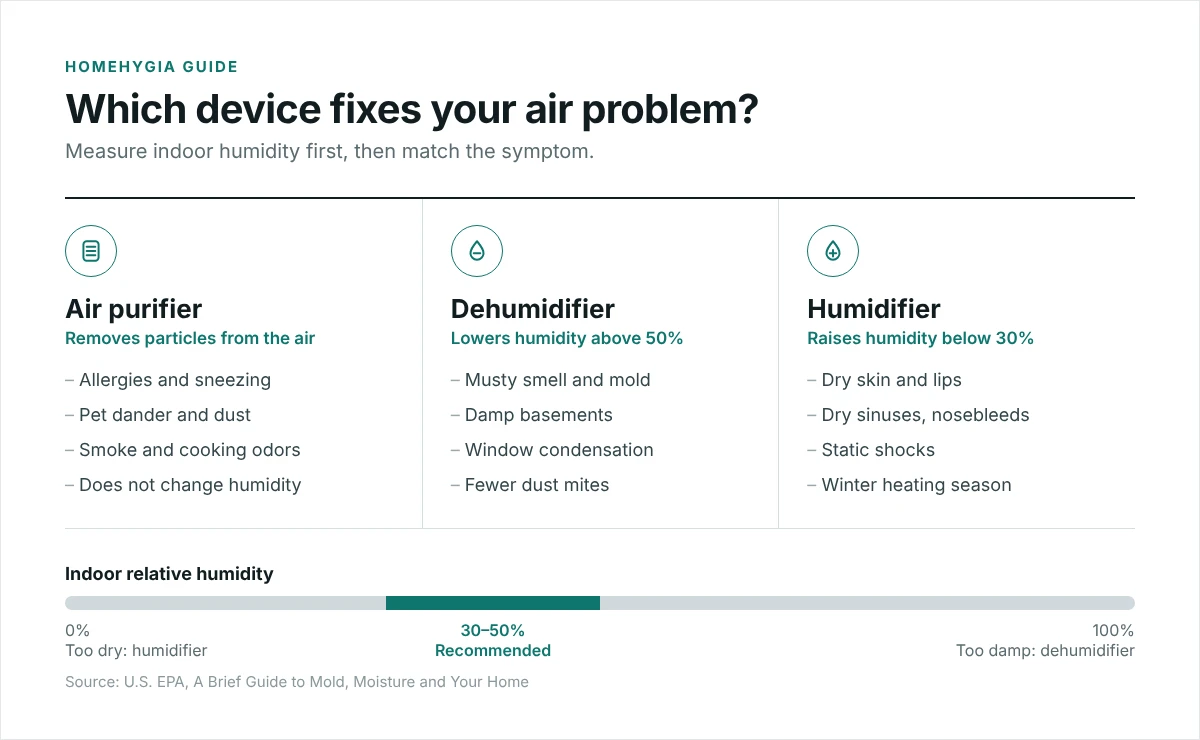
Air purifier: cleans what is in the air
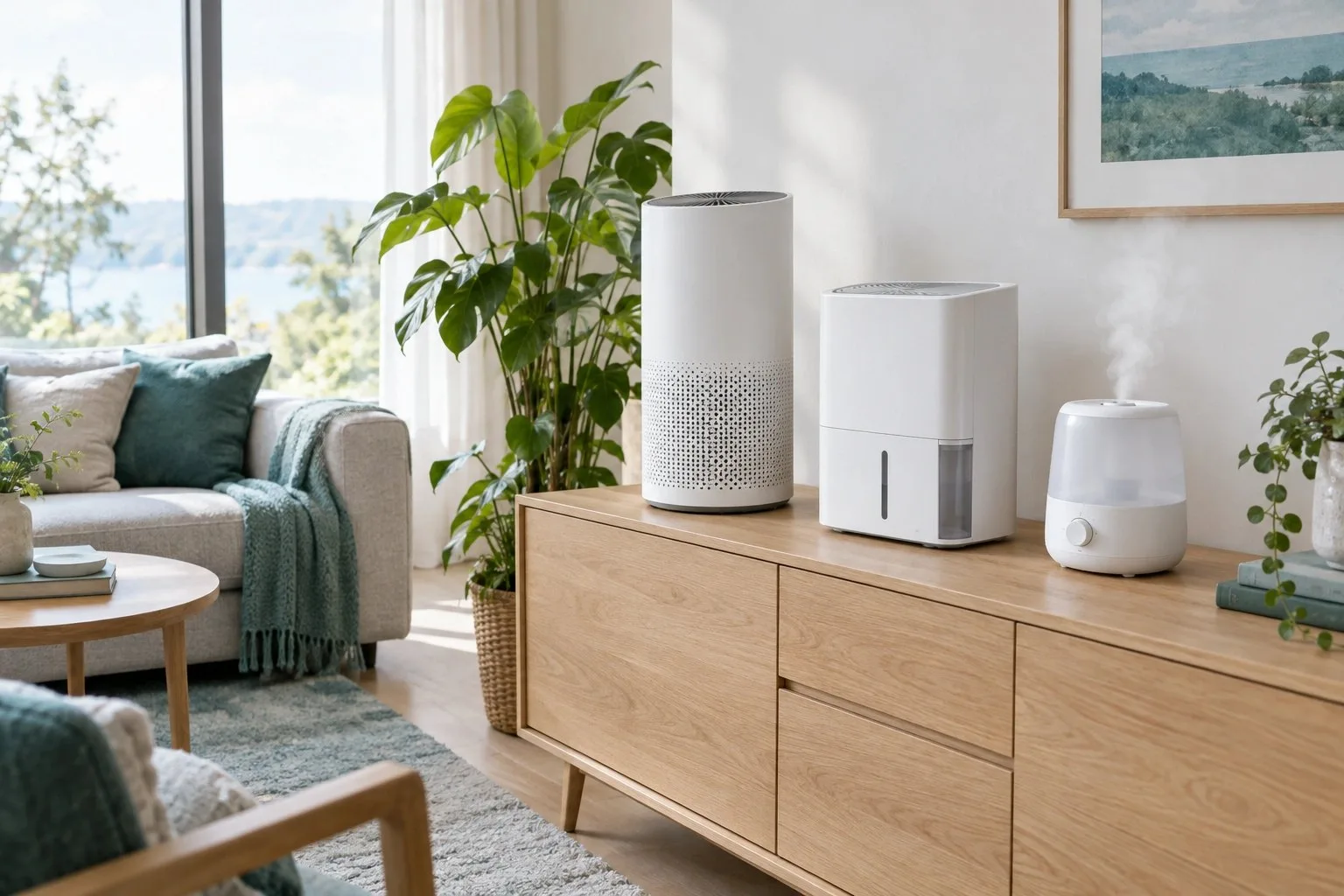
An air purifier pulls room air through a filter and blows it back out cleaner. It does nothing to humidity. A true HEPA filter must capture at least 99.97% of particles 0.3 microns in size, which covers pollen, pet dander, dust and most smoke particles. An activated carbon layer adds odor and gas control, and a washable pre-filter catches hair and lint so the HEPA filter lasts longer.
How to size one: look for the CADR (Clean Air Delivery Rate) number on the box. A common rule from AHAM is that the smoke CADR should be at least two-thirds of the room’s floor area. A 300 sq ft bedroom needs a smoke CADR of about 200 or more.
Watch out for: ionizers and “ozone” purifiers. Ozone irritates the lungs, and the EPA advises against ozone generators in occupied rooms. If a model has an ionizer, check that it is certified as low-ozone or that you can switch it off.
Dealing with mold too? See the best air purifier filter for mold.
Dehumidifier: takes moisture out
A dehumidifier draws humid air over cold coils. Water condenses on the coils and drips into a tank or out through a drain hose, and drier air goes back into the room. Desiccant models absorb moisture instead and work better in cold spaces like an unheated garage.
The EPA says keeping humidity below 60%, and ideally between 30% and 50%, is one of the main ways to prevent mold. Lower humidity also slows dust mites, which are a major allergy trigger. A dehumidifier does not remove dust or pollen, though, and it will not fix a leak. Find and stop the water source first.
How to size one: capacity is listed in pints per day. Small damp rooms do fine with about 20–35 pints; a large or wet basement usually needs 50 pints or more. Pick a model with a built-in humidistat and a continuous drain option if you don’t want to empty a tank every day.
Still torn between the two? Read air purifier filter vs dehumidifier.
Humidifier: adds moisture back
A humidifier puts water vapor into the air. It helps most in winter, when heating dries indoor air, and in dry climates. The main types are:
- Evaporative (cool mist): a fan blows air through a wet wick. Self-limiting and leaves no white dust, but the wick needs replacing.
- Ultrasonic (cool mist): a vibrating plate creates a fine, quiet mist. Use distilled water, or minerals come out as white dust.
- Warm mist (steam): boils water, so the mist is cleaner, but the hot water is a burn risk around children and pets.
The EPA warns that dirty humidifiers can spread bacteria and mold into the air. Empty the tank and dry it daily, clean it every third day, and use distilled or demineralized water. Do not push humidity above 50%, or you trade dry air for condensation and mold.
Can you use them together?
Yes, some pairs work well:
- Air purifier + dehumidifier: the best pair for humid homes with allergies. The dehumidifier controls mold and dust mites, and the purifier catches pollen and dander.
- Air purifier + humidifier: a good winter pair. Keep them a few feet apart so the purifier’s filter doesn’t pull in mist.
- Humidifier + dehumidifier in the same room: no. They cancel each other out and waste energy. It can make sense in different parts of the house, such as a dehumidifier in the basement and a humidifier in a dry bedroom.
Keep a hygrometer in the room and aim for the 30–50% range.
Buying checklist
- Air purifier: true HEPA, CADR that matches your room, filter cost per year, noise on the low setting, no ozone.
- Dehumidifier: pints per day for your space, ENERGY STAR rating, built-in humidistat, continuous drain, auto-restart after power cuts.
- Humidifier: output for your room size, built-in humidistat or auto shut-off, a wide tank opening that is easy to clean, cool mist if you have kids.
Maintenance at a glance
| Device | Weekly | Every few months |
|---|---|---|
| Air purifier | Vacuum or rinse the pre-filter | Replace HEPA and carbon filters as the maker recommends (often 6–12 months) |
| Dehumidifier | Empty and rinse the tank | Wash the air filter; check coils for dust and frost |
| Humidifier | Empty and dry daily; clean every third day | Replace the wick or filter; descale with vinegar |
Frequently asked questions
Can an air purifier remove humidity?
No. An air purifier filters particles and odors but does not change moisture levels. To lower humidity you need a dehumidifier or an air conditioner.
Does a dehumidifier clean the air?
Only indirectly. Lower humidity slows mold and dust mites, but a dehumidifier does not catch pollen, dander or smoke. Pair it with an air purifier if you have allergies.
Can I use a humidifier and a dehumidifier at the same time?
Not in the same room. They work against each other. Using them in different rooms with different needs is fine.
Which is better for allergies?
An air purifier with a true HEPA filter is the first choice for pollen and pet dander. If your home is also above 50% humidity, add a dehumidifier to control dust mites and mold.
Which is better for a baby’s room?
If the air is dry in winter, a cool mist humidifier, cleaned often and kept at 30–50%, is the usual choice. Avoid warm mist units because of burn risk. An air purifier is a good addition if anyone smokes nearby or you have pets.
What is the ideal indoor humidity?
Between 30% and 50%, according to the EPA. Above 60%, mold and dust mites thrive; below 30%, skin and sinuses dry out.
How often should I change an air purifier filter?
Most HEPA filters last 6–12 months and carbon filters often less. Heavy smoke, pets or a filter-change light may mean sooner. Follow the manufacturer’s schedule.
Can a humidifier cause mold?
Yes, in two ways: a dirty tank can grow mold and spray it into the air, and running it too high causes condensation on walls and windows. Clean it often and keep humidity under 50%.
The bottom line
Match the machine to the problem: an air purifier for particles, a dehumidifier for damp air, and a humidifier for dry air. Measure humidity first, aim for 30–50%, and combine an air purifier with whichever humidity device your home needs.
Sources
- EPA: A Brief Guide to Mold, Moisture and Your Home
- EPA: Use and Care of Home Humidifiers
- EPA: Guide to Air Cleaners in the Home
- EPA: What is a HEPA filter?
- AHAM Verifide: Room Air Cleaners