
Why Does My Vacuum Keep Blowing Fuses?

Quick Answer
A vacuum that keeps blowing fuses may be overloading the circuit, drawing excessive current because of an internal fault, or operating with a damaged plug or power cord. Stop repeatedly replacing or resetting the protection device until you know why it is happening; vacuum electrical-safety guidance recommends stopping use when fuses blow or breakers repeatedly trip.
Common reasons your vacuum blows a fuse
- Overloaded circuit: The vacuum may share a circuit with several other appliances.
- Damaged cord or plug: Cracked insulation, bent connections, or heat damage can create an electrical fault.
- Internal vacuum fault: Problems involving the motor, switch, wiring, or electronics can cause abnormal current draw.
- Incorrect fuse: The wrong fuse type or rating can cause problems and must never be replaced with a higher rating as a workaround.
- Restricted operation: Severe clogs or a jammed brush can strain the vacuum, although a repeated electrical trip still needs proper diagnosis.
What to do first
- Unplug the vacuum, inspect its visible cord and plug, and avoid opening the motor or electrical housing yourself.
When a vacuum blows a fuse, I treat it differently from ordinary suction trouble. A fuse or circuit breaker is there to interrupt an unsafe electrical condition.
The good news is that a few safe observations can narrow down the problem. This guide covers overloaded circuits, vacuum faults, cords, plugs, clogs, and the point where DIY troubleshooting should stop.
In This Guide
- Why does my vacuum keep blowing fuses?
- Is the problem the vacuum or the house circuit?
- What should I check safely before using the vacuum again?
- Can a clogged or overheating vacuum blow a fuse?
- When should a vacuum that blows fuses be professionally repaired?
- How can I prevent vacuum electrical problems?
- Vacuum blowing fuses FAQ
Why Does My Vacuum Keep Blowing Fuses?
Your vacuum keeps blowing fuses because the electrical protection device is detecting more current than the circuit should safely carry. The cause may be an overloaded household circuit or a fault inside the vacuum.
A blown fuse means the fuse element has opened the electrical circuit. A circuit breaker performs a similar protective job but normally trips instead of needing replacement.
- Circuit overload: A vacuum can add substantial demand to a circuit already powering other equipment.
- Short circuit or internal fault: Damaged wiring, a faulty motor, switch trouble, or another electrical failure can cause excessive current.
- Damaged power lead: Vacuum cords get pulled, twisted, pinched, and wrapped repeatedly, making visible damage important to investigate.
- Plug or connection damage: Scorching, looseness, melting, or unusual heat around a plug requires immediate attention.
- Household wiring problem: A weak connection, overloaded branch circuit, damaged receptacle, or another wiring fault may be involved.
The timing also provides clues. A fuse that opens the instant you switch on the vacuum suggests a different problem from one that opens after several minutes.
However, timing is only a clue. It is not enough to prove whether the motor, cord, outlet, or household circuit is at fault.
If your plug contains a replaceable fuse, use only the correct specified type and rating. Electrical Safety First’s plug and fuse guidance warns against substituting a higher-rated fuse.
Section Takeaway: A fuse is not the problem itself. Repeatedly blowing one means an overload or electrical fault needs to be found rather than bypassed.
Is the Problem the Vacuum or the House Circuit?
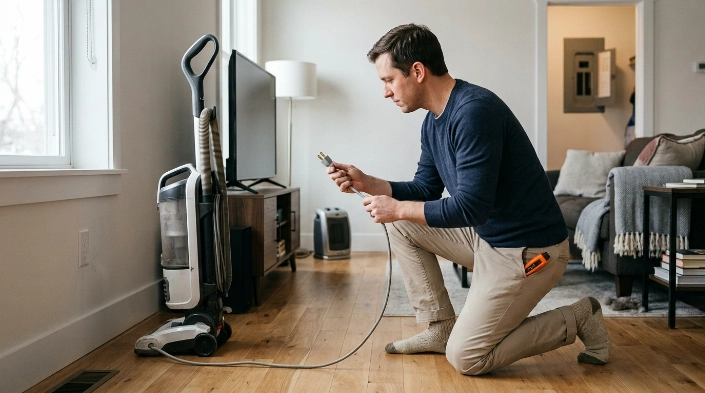
You can often narrow the problem by observing what happens around the vacuum. Avoid repeatedly powering a suspicious appliance just to reproduce the fault.
I start by asking what else lost power and what was operating at that moment. That information is more useful than immediately assuming the vacuum motor has failed.
| What You Notice | What It May Point Toward | Safest Response |
|---|---|---|
| Several appliances were running before the circuit opened | Possible circuit overload | Disconnect unnecessary loads and investigate the circuit capacity |
| Vacuum cord or plug looks scorched, cracked, or melted | Vacuum power-cord or connection fault | Stop using the vacuum and arrange repair |
| Outlet is hot, discolored, buzzing, or loose | Outlet or household wiring problem | Stop using that outlet and contact an electrician |
| Vacuum smells electrically burnt or produces sparks | Possible internal electrical fault | Disconnect it and do not restart it |
An overloaded circuit does not necessarily mean the vacuum is defective. The combined demand of several devices may exceed what that circuit can safely supply.
The Electrical Safety Foundation International’s home electrical guidance explains that overloaded circuits can trip breakers or open fuses. Continued trips deserve investigation.
Do not assume a power strip creates extra circuit capacity. It creates more connection points, not a larger electrical supply.
Expert Alert: If the outlet, fuse box, breaker panel, or fixed household wiring appears damaged, stop DIY troubleshooting. A qualified electrician should inspect it.
What Should I Check Safely Before Using the Vacuum Again?
Limit home troubleshooting to visible, non-electrical checks. Unplug the vacuum before inspecting its cord, filters, hose, brush roll, or dirt container.
- Disconnect the vacuum. Do not keep replacing the fuse and trying again.
- Inspect the full visible cord. Look for cuts, crushed sections, exposed conductors, melted insulation, or sharp kinks.
- Inspect the plug. Check for scorching, looseness, cracked plastic, bent pins, or signs of overheating.
- Check the receptacle visually. Do not use an outlet that is discolored, loose, cracked, buzzing, or unusually warm.
- Empty the bin or change the bag. A packed vacuum can run hotter and work harder.
- Check filters and airflow. Clean or replace filters only as the manufacturer directs.
- Clear the brush roll. Remove hair and fibers after disconnecting power.
- Read the owner’s manual. Follow model-specific fuse, reset, maintenance, and electrical instructions.
Do not open a motor housing to look for burnt wiring or test live electrical parts. Those checks require suitable training and test equipment.
The U.S. Consumer Product Safety Commission advises unplugging an appliance that repeatedly blows a fuse or trips a breaker. Its electrical safety recommendations call for repair or replacement rather than repeated resets.
Never install a larger fuse to stop the problem. That can remove protection the wiring was designed to have.
Can a Clogged or Overheating Vacuum Blow a Fuse?
A badly restricted or mechanically jammed vacuum can run abnormally hot and put extra strain on components. However, a repeatedly blown fuse should still be treated as an electrical warning.
Restricted airflow commonly starts in a few predictable places. These areas are safe to inspect after the vacuum is disconnected.
- Dust bin or bag: Packed debris restricts normal airflow.
- Filter: Heavy dust loading can make airflow harder to maintain.
- Hose or wand: Hair, paper, lint, and larger debris can create hidden clogs.
- Floor head: Debris can block the intake passage.
- Brush roll: Wrapped hair and thread can increase mechanical resistance.
A vacuum motor already produces heat during normal operation. Restricted airflow or a jammed moving part can increase abnormal heat and may trigger built-in protection on some models.
That is different from assuming every blown fuse comes from a dirty filter. If electrical protection keeps opening after basic maintenance, stop using the appliance.
- Electrical or burning-plastic smell
- Smoke or visible sparking
- Abnormally hot plug or cord
- Melting or discoloration
- Grinding, arcing, buzzing, or unusual motor sounds
- Repeated fuse operation after the vacuum is cleaned
Section Takeaway: Clearing clogs is worthwhile maintenance, but it is not a substitute for electrical diagnosis when a fuse repeatedly opens.
When Should a Vacuum That Blows Fuses Be Professionally Repaired?
Arrange professional help when the problem goes beyond visible maintenance. Repeated fuse operation is enough reason to stop treating the issue as a simple cleaning problem.
The correct professional depends on where the evidence points. An appliance technician handles vacuum faults, while an electrician handles fixed household wiring and circuit problems.
| Problem | Who to Contact | Why |
|---|---|---|
| Damaged vacuum cord, switch, motor, or internal electronics | Qualified appliance technician or manufacturer service center | The fault is within the appliance |
| Warm, buzzing, loose, or scorched wall outlet | Qualified electrician | Fixed wiring or receptacle may be unsafe |
| Several appliances cause the same circuit to trip | Qualified electrician | Circuit loading or wiring should be assessed |
| Vacuum repeatedly opens protection by itself | Appliance technician or manufacturer | Internal electrical failure becomes more likely |
The Electrical Safety Foundation International recommends unplugging appliances that repeatedly blow fuses or trip breakers. Repair or replacement is safer than continuing to operate a suspected defective appliance.
Expert Alert: Never bypass a fuse, breaker, thermal protector, safety switch, or grounding connection. Internal electrical repair should be left to a qualified professional.
How Can I Prevent Vacuum Electrical Problems?
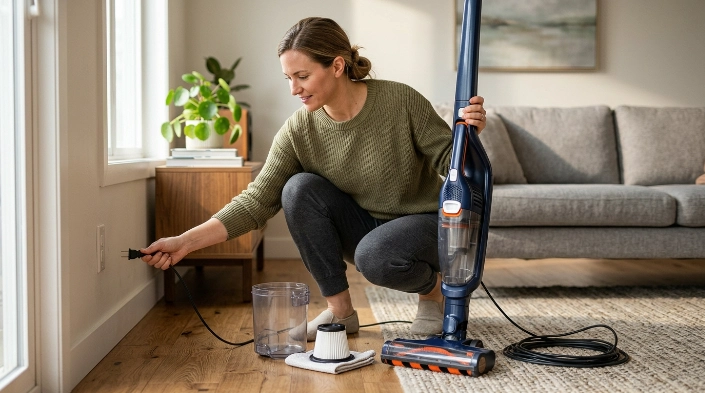
Good vacuum care reduces mechanical strain and helps you notice electrical problems sooner. It cannot prevent every component failure, but it makes warning signs easier to spot.
- Check the cord regularly: Watch for cuts, crushing, exposed wire, loose strain relief, or damage near the plug.
- Pull the plug correctly: Grip the plug instead of yanking the cord from the outlet.
- Maintain airflow: Empty the bin, replace bags, and service filters according to the manual.
- Clean the brush roll: Remove hair and thread before resistance becomes severe.
- Avoid questionable extension leads: Use the vacuum according to its manufacturer’s electrical instructions.
- Notice heat early: Investigate an unusually hot plug, cord, outlet, or vacuum instead of finishing the cleaning job first.
- Respect unusual smells: Burning rubber may indicate mechanical friction, while an electrical odor needs greater caution.
As of 2026, the owner’s manual remains the most reliable source for your model’s maintenance and electrical requirements. Fuse ratings and service procedures vary between products and markets.
I also avoid treating a fuse as a consumable vacuum part. If replacements keep failing, something upstream is asking the fuse to protect the circuit.
Vacuum Blowing Fuses FAQ
Can a vacuum cleaner be too powerful for an outlet?
The issue is usually the total load and condition of the circuit rather than an outlet simply being “too weak.” A heavily loaded circuit may open its fuse or breaker when the vacuum adds more demand.
Why does the fuse blow as soon as I switch the vacuum on?
An immediate failure may indicate an overload, damaged cord, short circuit, motor problem, or another electrical fault. Do not keep replacing the fuse to see whether the problem eventually disappears.
Can a dirty vacuum filter cause a fuse to blow?
A dirty filter can restrict airflow and contribute to abnormal heat or poor performance. However, repeated fuse operation is an electrical safety symptom and should not be blamed on the filter without proper diagnosis.
Should I use a bigger fuse for my vacuum cleaner?
No. Use only the fuse type and rating specified for the appliance or circuit. Installing a higher-rated fuse to stop repeated failures can defeat important overcurrent protection and create a fire hazard.
Why does my vacuum trip the breaker instead of blowing a fuse?
Fuses and circuit breakers perform similar overcurrent-protection roles but operate differently. A fuse opens permanently and needs replacement, while a standard breaker can normally be reset after the underlying problem is corrected.
Is it safe to keep using a vacuum after replacing the fuse?
One isolated fuse failure still deserves investigation, especially if the cause is unclear. If the replacement fuse also blows, disconnect the vacuum and arrange professional diagnosis rather than continuing to test it.
Does a burning smell mean the vacuum motor is bad?
Not always. A hot rubber smell can come from a jammed roller or belt, while an electrical smell may involve the motor, wiring, switch, cord, or electronics. Smoke, sparks, melting, or persistent electrical odor means you should stop using the vacuum.
Final takeaway: A vacuum that keeps blowing fuses is giving you a safety warning, not asking for an endless supply of replacement fuses. Check visible damage, airflow, and circuit loading, then stop and call the appropriate professional if the fault repeats.
