
Why Is My Vacuum Cleaner Tripping the Breaker? Causes and Safe Fixes

Quick Answer
A vacuum cleaner usually trips a breaker because the circuit is overloaded, the vacuum has an electrical fault, or an AFCI/GFCI device is detecting an unsafe condition. A damaged cord, plug, motor, or internal connection can also be responsible. The Electrical Safety Foundation International explains how breakers protect overloaded circuits by interrupting electrical current before wiring overheats.
Check these likely causes first
- Shared circuit overload: Your vacuum may be running alongside heaters, appliances, computers, or other high-load devices.
- Damaged power cord: Cuts, crushed insulation, loose plugs, or exposed wiring can create an electrical fault.
- Internal vacuum fault: Motor, switch, wiring, or electrical component damage can cause excessive current or leakage.
- AFCI or GFCI trip: These protective devices may be responding to arcing or current leaking toward ground.
- Circuit problem: A loose outlet, damaged branch wiring, or failing breaker may require an electrician.
Stop using the vacuum immediately if:
- You notice sparks, smoke, a burning smell, melted plastic, exposed wiring, or an unusually hot plug or outlet.
A breaker that trips the moment you start vacuuming can be frustrating, but I don’t treat repeated trips as a minor inconvenience. The breaker is a safety device, and repeatedly resetting it without finding the cause can hide a serious electrical problem.
As of 2026, my troubleshooting order is simple: reduce the circuit load, inspect the vacuum, identify the breaker type, and stop before any testing that requires opening electrical equipment.
In This Guide
Why Does a Vacuum Cleaner Trip a Circuit Breaker?
A vacuum trips a breaker when the electrical protection system detects conditions outside the circuit’s intended operating range. Depending on the protection installed, that may mean excessive current, an arc-like fault, or electricity leaking toward ground.
A circuit breaker is a safety switch that interrupts electricity when an unsafe electrical condition is detected. It is designed to protect wiring and reduce electrical fire risk, not simply to act as an on-off switch.
Standard breakers mainly provide overcurrent protection. AFCI and GFCI protection can respond to different fault conditions that a standard breaker may not detect in the same way.
- Standard breaker: Protects wiring against excessive current caused by overloads and short circuits.
- AFCI protection: Designed to detect certain dangerous electrical arcing conditions.
- GFCI protection: Responds to current taking an unintended path toward ground, helping protect against electric shock.
A vacuum cleaner can be a significant electrical load. In a typical U.S. 120-volt home, a 1,200-watt appliance represents roughly 10 amps using the simple watts ÷ volts calculation.
The vacuum’s actual nameplate amp rating is more useful than estimating from watts. Motors also behave differently during startup than simple resistive loads.
Imagine a vacuum rated near 10 or 12 amps sharing a circuit with a portable heater, dehumidifier, or another appliance. The combined load can push the branch circuit beyond what its breaker permits.
That does not automatically mean the vacuum is defective. It may mean too many electrical loads are using the same circuit.
What Are the Most Common Causes?
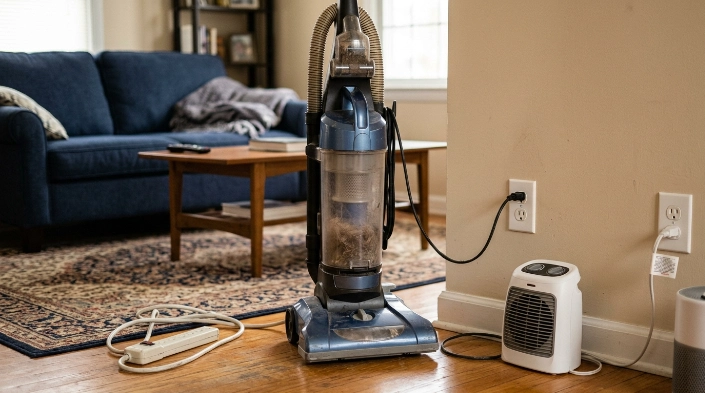
The most useful clue is when and where the breaker trips. An immediate trip, delayed trip, GFCI trip, and one-circuit-only problem point toward different causes.
1. Too many appliances are sharing the circuit
Circuit overload is one of the first things I check. A vacuum can share a branch circuit with outlets you would not necessarily expect to be connected together.
Turn off or unplug other substantial loads on that circuit before trying the vacuum again. Heaters, air conditioners, hair dryers, microwaves, and similar appliances deserve particular attention.
- Vacuum runs when other devices are disconnected: a circuit overload becomes more likely.
- Vacuum still trips an otherwise lightly loaded circuit: investigate the vacuum or electrical system further.
- Multiple outlets lose power together: they probably belong to the same branch circuit.
2. The vacuum’s cord or plug is damaged
A vacuum cord gets dragged, twisted, stepped on, pinched under furniture, and repeatedly wrapped around the machine. Damage can develop at the plug, strain relief, or anywhere along the insulation.
Inspect the cord while the vacuum is unplugged. Look for cracks, cuts, flattened areas, loose prongs, discoloration, scorch marks, or exposed conductors.
The U.S. Consumer Product Safety Commission provides broader household electrical safety guidance covering electrical products and damaged electrical equipment.
Expert Alert: Do not tape over exposed vacuum wiring and continue using it. Cord, plug, switch, motor, or internal wiring repairs should be handled by a qualified appliance technician or electrician when appropriate.
3. The vacuum has an internal electrical fault
A failing motor, switch, capacitor, connector, or internal wire can create a fault that trips the breaker. This becomes more suspicious when the same vacuum trips breakers on more than one known-good circuit.
Do not open the motor housing to investigate unless you are qualified to repair electrical appliances. Capacitors and energized components can create hazards even when a problem appears simple.
4. An extension cord or power strip is involved
I prefer testing a corded vacuum directly from a suitable wall outlet. An undersized, damaged, or overloaded extension cord adds another possible failure point.
CPSC advises consumers not to overload extension cords and to replace damaged cords. Its extension-cord safety guidance is worth reviewing if you normally vacuum through an extension lead.
5. The outlet, wiring, or breaker has a problem
Sometimes the vacuum is only exposing an existing household electrical problem. A worn outlet, loose connection, damaged wiring, or deteriorated breaker can cause repeated trips.
If several appliances cause trouble on the same circuit, the branch circuit deserves professional inspection. Do not replace a breaker with a higher-amp model as a workaround.
6. Restricted airflow is being mistaken for a breaker problem
A packed bin, blocked hose, dirty filter, or tangled brush can make some vacuums overheat or shut themselves down. However, an appliance’s internal thermal shutdown is different from a household breaker physically tripping.
Clean obvious blockages according to the manufacturer’s instructions, but don’t assume a clogged filter explains repeated breaker trips. Electrical faults still need to be ruled out.
Section Takeaway: Repeated breaker trips usually deserve more attention than routine vacuum maintenance. Start with circuit load and visible cord damage, then stop using the appliance if the electrical fault follows the vacuum.
How Do You Troubleshoot a Vacuum That Trips the Breaker?
Start with checks that do not require opening an outlet, breaker panel, or vacuum motor. The goal is to separate an obvious overload from a potentially dangerous electrical fault.
Step 1: Unplug the vacuum
Disconnect the machine before inspecting anything. Do not repeatedly reset the breaker while leaving a suspect appliance connected.
Step 2: Inspect the cord, plug, and vacuum body
- Look for cracked, crushed, or missing insulation.
- Check the plug for looseness, discoloration, or melted material.
- Look for water exposure around the vacuum or outlet.
- Notice any burnt smell coming from the motor or plug.
- Check whether the vacuum became unusually hot before the trip.
If you find any of these warning signs, stop troubleshooting by powering the machine again.
Step 3: Reduce the load on the circuit
Unplug other substantial appliances served by the same circuit. Then reset the breaker once, following the breaker’s normal reset procedure.
If the vacuum now runs normally, shared circuit load may have caused the original trip. You still need to manage that load rather than repeatedly overloading the circuit.
Step 4: Remove extension cords and power strips
When appropriate for your vacuum and outlet, plug the machine directly into a properly installed wall receptacle. This removes an extension cord or power strip from the troubleshooting chain.
Do not use an adapter to defeat a grounding connection. Never remove a grounding prong to make a plug fit.
Step 5: Check basic vacuum maintenance items
- Empty an overfilled dust container.
- Replace a full disposable bag.
- Inspect the hose and intake for clogs.
- Remove hair from the brush roll.
- Clean or replace filters only as the manufacturer instructs.
These checks help rule out overheating and mechanical strain. They should not be treated as a repair for damaged electrical components.
Step 6: Compare the trip pattern
If there is no visible damage, note whether the breaker trips instantly or after the vacuum has operated for a while. Also identify whether you are resetting a standard breaker, AFCI, GFCI, or dual-function device.
Testing the vacuum on another known-good circuit can sometimes help isolate the problem, but only when the appliance shows no signs of electrical damage, overheating, sparking, smoke, or burning.
If it trips another correctly functioning circuit, stop using it. Appliance service is the safer next step.
Expert Alert: Never remove the electrical panel cover, tighten breaker terminals, change circuit wiring, or substitute a larger breaker as a DIY troubleshooting step. Those tasks belong to a qualified electrician.
Section Takeaway: A safe diagnosis should narrow the problem without bypassing any protection. If the fault follows the vacuum or you see heat, sparks, damaged insulation, or burning, disconnect it and arrange professional service.
How Can You Tell Whether the Vacuum or Circuit Is the Problem?
The trip pattern gives useful clues, although it cannot replace proper electrical testing. I use the following comparison as a decision guide rather than a final diagnosis.
| What happens | What it may suggest | Safer next step |
|---|---|---|
| Breaker trips immediately when vacuum starts | Heavy overload, short circuit, cord fault, or internal appliance fault | Unplug the vacuum and inspect it before another attempt |
| Breaker trips only when other appliances are running | Shared circuit overload | Reduce simultaneous loads on that circuit |
| Vacuum trips different breakers in different rooms | Vacuum fault becomes more likely | Stop using it and arrange appliance inspection |
| Several appliances trip the same circuit | Circuit, outlet, wiring, or breaker problem | Have a qualified electrician inspect the circuit |
| Only the GFCI trips | Possible current leakage toward ground | Disconnect the vacuum and investigate the appliance and circuit |
| Only the AFCI trips | Possible arc-related fault or compatibility issue requiring proper diagnosis | Do not bypass the AFCI; seek qualified inspection if repeated |
A single successful test does not prove the appliance is completely safe. Intermittent cord and motor faults can appear only when the vacuum moves, heats up, or operates under certain conditions.
Does the Type of Breaker Matter?

Yes. A standard breaker, AFCI, and GFCI are designed to respond to different electrical hazards, so identifying what actually tripped can narrow the investigation.
Standard circuit breaker
A standard breaker primarily protects branch-circuit wiring against excessive current. Overloaded circuits and short circuits are common reasons it may open.
AFCI protection
An arc-fault circuit interrupter watches for electrical characteristics associated with dangerous arcing. Damaged wiring, cords, connections, or appliances can be involved when AFCI protection repeatedly trips.
ESFI’s 2024 AFCI and GFCI performance survey reported that contractors frequently encountered overloads, wiring problems, and evidence of dangerous arcing while responding to breaker-related service calls.
GFCI protection
A ground-fault circuit interrupter is intended to reduce shock risk by opening the circuit when current follows an unintended path. GFCI protection is particularly important where electricity may be near water.
If your vacuum repeatedly trips a GFCI, do not defeat that protection by moving through adapters or altering the receptacle. Moisture, cord damage, motor problems, or another electrical fault should be investigated.
When should you call an electrician?
- The breaker trips with several different appliances.
- An outlet is warm, buzzing, loose, scorched, or discolored.
- You smell burning near an outlet or breaker panel.
- The breaker will not reset after loads are disconnected.
- The breaker trips repeatedly with no obvious overload.
- You suspect damaged household wiring.
Call an appliance repair professional when the evidence follows the vacuum itself, especially when its cord, plug, switch, or motor appears defective.
Expert Alert: Frequent breaker trips indicate a condition worth investigating. Do not bypass AFCI/GFCI protection or increase a breaker’s rating to keep the vacuum running.
Frequently Asked Questions
Can a vacuum cleaner overload a circuit?
Yes. A corded vacuum can use a substantial portion of a household branch circuit’s available current. If heaters, appliances, or other significant loads are running on the same circuit, their combined demand can cause the breaker to trip.
Why does my breaker trip as soon as I turn the vacuum on?
An immediate trip can point toward a heavy overload, short circuit, damaged power cord, or internal vacuum fault. Unplug the vacuum and inspect it before trying again. Sparks, burning smells, melted parts, or exposed wiring mean you should stop using it.
Why does the vacuum run for a few minutes before tripping the breaker?
A delayed trip may happen when a circuit remains overloaded long enough for protection to operate, or when an appliance develops an electrical problem as it heats up. Note what else is running and stop if the vacuum becomes unusually hot or smells burnt.
Can a clogged vacuum filter trip the house breaker?
A clogged filter can restrict airflow and contribute to overheating or an appliance’s own thermal shutdown. However, it should not automatically be blamed for a household breaker trip. Repeated branch-circuit trips deserve proper electrical troubleshooting.
Should I replace the breaker with a larger one?
No. A breaker must match the wiring and circuit design. Installing a higher-rated breaker without verifying conductor size and circuit requirements can remove essential protection. A qualified electrician should determine whether the circuit itself needs repair or upgrading.
Is it safe to keep resetting a breaker after the vacuum trips it?
No. One reset after removing a known overload can be reasonable, but repeated resetting without identifying the cause is not good troubleshooting. Disconnect the vacuum if the breaker continues to trip and have the appliance or electrical circuit inspected.
Final Takeaway: If your vacuum cleaner keeps tripping the breaker, start by reducing other circuit loads and inspecting the cord and plug. If the problem follows the vacuum, affects AFCI/GFCI protection, produces heat or burning smells, or keeps happening without an obvious overload, stop using the machine and get qualified help.
