
How to Vacuum Fireplace Ash Safely

Quick Answer
To vacuum fireplace ash safely, let the fire and ash cool completely, check carefully for hidden embers, and use a dedicated ash vacuum designed for cold fireplace ash. Never assume a regular household vacuum is safe for the job, and follow EPA guidance for handling cooled wood ash before disposal.
Quick fireplace ash vacuuming steps
- Let it cool: Do not vacuum until the ash, coals, and surrounding firebox are completely cold.
- Check for embers: Move the ash gently with a metal fireplace poker and inspect below the surface.
- Use an ash vacuum: Choose a model whose manufacturer specifically approves it for cold fireplace or wood-stove ash.
- Vacuum slowly: Keep the nozzle near the ash and avoid aggressive movements that send fine dust airborne.
- Watch the filter: Stop if suction drops and clean or service the filter exactly as your vacuum manual directs.
- Dispose safely: Transfer cooled ash to a suitable metal container and keep it away from combustible materials.
Fireplace ash looks harmless once the flames disappear, but fine ash dust and hidden embers make cleanup different from normal household vacuuming. For good home hygiene and indoor air quality, I treat fireplace cleaning as a dust-control job first and a vacuuming job second.
The method below covers the vacuum, preparation, cleanup, ash disposal, and mistakes that can turn a simple chore into a dusty or unsafe one.
In This Guide
- Can You Vacuum Fireplace Ash Safely?
- What Type of Vacuum Should You Use for Fireplace Ash?
- How Do You Vacuum Fireplace Ash Step by Step?
- How Do You Keep Fireplace Ash Dust From Spreading?
- How Should You Empty and Dispose of Fireplace Ash?
- What Fireplace Ash Vacuuming Mistakes Should You Avoid?
- Fireplace Ash Vacuuming FAQ
Can You Vacuum Fireplace Ash Safely?
Yes, you can vacuum fireplace ash, but only after it is completely cold and with equipment approved for that purpose. A standard household vacuum is not the tool I would reach for.
Definition: An ash vacuum is a vacuum designed to collect fine, cold ash from fireplaces, wood stoves, pellet appliances, grills, or similar fire features, depending on the manufacturer’s approved uses.
Why regular vacuum cleaners are a poor choice
Fireplace ash is much finer than the crumbs, hair, and household dust most upright, canister, robot, and stick vacuums handle. It can load a filter quickly and may reach parts of a machine that were never designed for fireplace debris.
More importantly, an ember can remain beneath apparently cool ash. Plastic hoses, bins, bags, and other components in ordinary vacuums aren’t designed as a safeguard against that possibility.
Kärcher’s fireplace-cleaning guidance specifically advises against conventional household vacuums and recommends equipment designed for ash.
Cold-looking ash is not enough
The top layer can feel cool while material underneath remains warm. I always disturb the ash gently with a metal poker before bringing any vacuum nozzle into the firebox.
- Look for glowing material: Inspect beneath logs, charcoal pieces, and thicker ash deposits.
- Check for heat: Do not proceed if any area feels warm or gives off noticeable heat.
- Do not trust elapsed time alone: Cooling time varies with fire size, fuel, ash depth, and fireplace design.
- Follow your appliance manual: Fireplace and stove manufacturers may specify their own ash-removal procedures.
As of 2026, the practical rule remains simple: an ash vacuum is for ash that you have verified is safe under that machine’s instructions.
What Type of Vacuum Should You Use for Fireplace Ash?
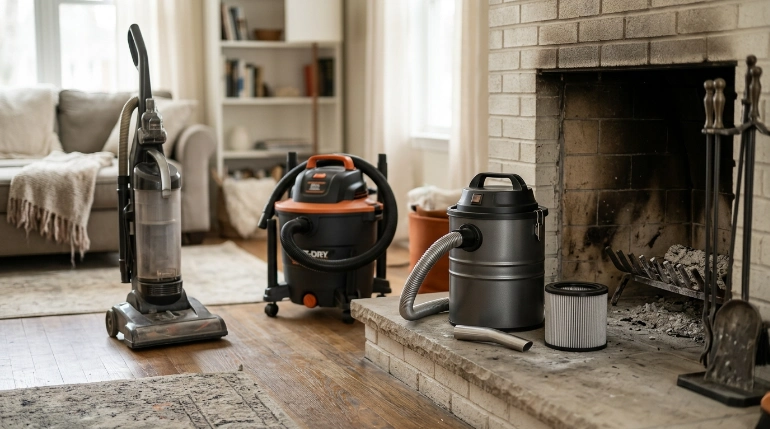
A dedicated ash vacuum is usually the most appropriate choice. Do not assume that a HEPA household vacuum or ordinary wet/dry shop vacuum becomes an ash vacuum just because it has strong suction.
HEPA filtration describes particle filtration performance under defined conditions. It does not, by itself, mean the machine is constructed or approved for fireplace ash.
| Vacuum type | Fireplace ash use | Key concern | My rule |
|---|---|---|---|
| Regular household vacuum | Not recommended | Fine ash, unsuitable components, filter loading | Keep it away from the firebox |
| Standard wet/dry shop vacuum | Only if its manufacturer specifically approves the intended ash setup | Not every shop vacuum is designed for fine ash | Check the exact manual first |
| Dedicated ash vacuum | Designed for approved ash-cleaning applications | Temperature limits and filter requirements still apply | Best general choice for cold fireplace ash |
Some ash-vacuum systems use metal canisters and metal or metal-lined suction components. Filter designs also vary, so I never assume two ash vacuums have the same operating limits.
For example, Kärcher’s published fireplace guidance says ash should cool below 104°F (40°C) before vacuuming and advises checking for hidden embers. Treat that as a manufacturer example, not a universal limit for every ash vacuum.
What features matter most?
- Explicit ash rating: The manufacturer should identify fireplace or stove ash as an approved use.
- Cold-ash instructions: Look for a clear temperature or cooling requirement.
- Suitable container: Ash vacuums commonly use construction intended for fireplace debris.
- Fine-dust filtration: The filter should be the exact type specified for ash collection.
- Serviceable filter: Fine ash loads filters quickly, so easy maintenance helps.
- Metal pickup components: Use the hose, wand, and nozzle arrangement specified by the manufacturer.
How Do You Vacuum Fireplace Ash Step by Step?

The safest process starts before you switch on the vacuum. My routine is to verify the firebox first, prepare the machine second, and only then start collecting ash.
1. Let the fireplace become completely cold
Stop using the fireplace and give the entire firebox enough time to cool. There should be no active flame, glowing coal, smoldering wood, or noticeable heat.
EPA’s information on wood-burning appliances and fireplaces also helps explain why wood combustion produces fine particles and why fireplace operation affects indoor air quality.
2. Inspect underneath the ash
Use a metal poker or similar fireplace tool to gently move the top layer. Pay special attention to large charcoal pieces and dense piles where heat can remain hidden.
- Break apart suspicious clumps carefully.
- Look underneath partially burned wood.
- Stop if you see glow or smoke.
- Stop if you detect warmth.
Do not rely only on touching the surface with your hand. You should not put your hand into the ash to search for embers.
3. Remove oversized debris first
Large charcoal chunks, nails from burned pallet material, or pieces of wood can block a narrow hose. Use proper fireplace tools to remove material that your ash vacuum manual says not to collect.
Place anything removed from the firebox into an appropriate noncombustible container. Treat questionable material as potentially hot.
4. Prepare the ash vacuum
Check the canister, filter, hose, and attachments before starting. A filter that is missing, damaged, incorrectly installed, or overloaded can defeat the dust-control advantage of the machine.
- Install the specified filter correctly.
- Empty an already-full canister.
- Check the hose for obstructions.
- Use only approved attachments.
- Keep the exhaust away from loose ash.
5. Vacuum slowly from the surface downward
Keep the nozzle close to the ash instead of waving it above the pile. Fast movement can create a gray cloud before the vacuum has a chance to capture it.
I work in small sections and let the suction do the work. There is no benefit in digging aggressively through a deep ash bed.
- Start near one edge of the firebox.
- Collect the loose top layer slowly.
- Pause if you uncover larger debris.
- Recheck deeper material before continuing.
- Work toward corners and around the grate last.
6. Stop if suction falls sharply
Fine ash can load a filter faster than ordinary floor dust. Weak airflow, unusual motor sound, or visible dust escaping the machine means it is time to stop and inspect it.
Clean or replace the filter only as your vacuum manufacturer directs. Never run an ash vacuum without the required filtration installed.
Section Takeaway: Verify that every layer is cold, prepare the ash vacuum correctly, and collect ash with slow nozzle movements. Temperature checking matters more than finishing the job quickly.
How Do You Keep Fireplace Ash Dust From Spreading?
Move slowly and avoid dry sweeping whenever possible. Fine ash becomes much harder to control once it is floating through the room.
EPA describes source control, ventilation, and filtration as key parts of managing indoor air quality. For fireplace cleanup, the first goal is simple: avoid creating the dust cloud in the first place.
Use the nozzle as a dust-control tool
- Stay close: Hold the nozzle near the surface being collected.
- Move gently: Avoid plunging the hose into a deep ash pile.
- Limit traffic: Keep children and pets away during cleanup.
- Protect nearby surfaces: Avoid placing dusty tools on rugs or upholstered furniture.
- Check the exhaust: Stop if the vacuum appears to discharge dust back into the room.
Where does HEPA filtration fit?
A HEPA filter can be useful for fine-particle control when it is part of a machine designed for the task. But a HEPA label does not turn a regular stick, upright, or canister vacuum into a fireplace ash vacuum.
EPA’s guidance for reducing indoor exposure to smoke and airborne ash also emphasizes avoiding actions that stir ash into the air. Wildfire ash is not the same cleanup situation as ordinary wood-fireplace ash, but minimizing airborne dust is a useful shared principle.
Should you run an air purifier?
An air purifier may help capture some airborne particles after dust is already in room air, depending on its design and sizing. It should not replace safe source cleanup.
Keep the purifier far enough from the fireplace that its airflow does not blow loose ash around. CADR, or Clean Air Delivery Rate, matters when sizing an air cleaner, but it does not tell you whether a vacuum can safely collect fireplace ash.
How Should You Empty and Dispose of Fireplace Ash?
Assume collected ash deserves the same caution as ash still inside the fireplace. Empty the ash vacuum according to its manual and keep the process away from combustible materials.
The EPA advises putting cooled wood ash into a metal container away from flammable materials, including the house. I prefer to keep that container outside in an appropriate safe location rather than leaving a loaded ash vacuum indoors.
A simple disposal routine
- Switch off and unplug the vacuum.
- Move it to a suitable outdoor cleanup area if the manufacturer permits.
- Open the canister carefully to avoid releasing dust.
- Transfer ash into an appropriate metal container.
- Close the container securely.
- Store it away from the house and other combustible materials.
- Follow local rules before final disposal or reuse.
Do not dump questionable ash directly into a plastic trash bin, paper bag, cardboard box, mulch bed, or compost pile. Material that appears cold can still deserve conservative handling.
Can fireplace ash go in the garden?
Wood ash is sometimes used as a soil amendment, but that does not make every batch suitable for a garden. What was burned matters.
Do not treat ash from painted, pressure-treated, contaminated, or unknown wood as ordinary clean wood ash. Check local guidance before using ash around soil, plants, children, or pets.
What Fireplace Ash Vacuuming Mistakes Should You Avoid?
The biggest mistakes come from treating fireplace ash like normal household dirt. Heat, ultrafine dust, and fireplace residues require a different approach.
- Using a regular vacuum: Strong suction does not mean the machine is approved for ash.
- Vacuuming too soon: A cool surface does not prove deeper material is cold.
- Assuming every shop vac works: Check the exact manufacturer’s instructions before using one for ash.
- Trusting a HEPA label alone: Filtration efficiency and ash-safe construction are separate issues.
- Stirring the pile: Aggressive hose movement sends fine dust into the room.
- Ignoring filter maintenance: Ash can load a filter and reduce airflow quickly.
- Overfilling the canister: Follow the machine’s fill and maintenance limits.
- Leaving collected ash indoors: Dispose of it according to fireplace, vacuum, and local safety guidance.
Do not confuse ash cleaning with chimney cleaning
Vacuuming loose ash from a cold firebox is routine homeowner maintenance. Removing creosote from a chimney or diagnosing flue, draft, liner, or combustion problems is different work.
Expert Alert: If you see heavy creosote, damaged masonry, a blocked flue, smoke entering the room, or other chimney problems, stop DIY cleaning and contact a qualified chimney or hearth professional.
Fireplace Ash Vacuuming FAQ
Can I use my regular vacuum for fireplace ash?
No. A regular household vacuum is not designed as a fireplace ash vacuum, even if it has a HEPA filter. Fine ash can overload filtration, and household vacuum components are not intended to provide protection against hidden hot material.
Can I use a shop vac for fireplace ash?
Only if the manufacturer of that exact shop vacuum and setup specifically approves the intended ash-cleaning use. Do not assume a metal drum makes a wet/dry vacuum ash-safe. A dedicated cold-ash vacuum is the simpler choice for most households.
How long should fireplace ash cool before vacuuming?
There is no single waiting time that proves every fireplace is safe. Fire size, fuel, coal depth, and fireplace design affect cooling. Wait until everything is completely cold, inspect beneath the surface with fireplace tools, and follow your ash vacuum’s temperature instructions.
Can an ash vacuum pick up warm ashes?
Follow the exact temperature limit in your vacuum manual. Some published manufacturer guidance gives specific limits, but these are not universal. My safest rule is to avoid vacuuming until the ash is fully cooled and there are no hidden embers.
Do I need a HEPA filter for fireplace ash?
Use the filter system specified by your ash-vacuum manufacturer. HEPA filtration can help with fine-particle capture in suitable equipment, but a HEPA filter alone does not make an ordinary household vacuum safe or appropriate for fireplace ash.
Why does my ash vacuum lose suction quickly?
Fine ash can load or clog filters and restrict airflow. Stop the machine, let dust settle, and inspect the filter and hose according to the manual. Clean, replace, or service the filter only using the manufacturer’s recommended method.
Can I vacuum soot and creosote from my chimney?
Do not assume an ash vacuum is approved for chimney deposits. Loose fireplace ash and chimney creosote are different materials and cleaning jobs. If your chimney needs internal cleaning or inspection, use a qualified chimney professional rather than improvising with household equipment.
Final takeaway: The best way to vacuum fireplace ash is to make safety the first step. Verify that the firebox is completely cold, use a dedicated ash vacuum according to its manual, control fine dust, and dispose of the collected ash in an appropriate metal container away from combustible materials.
A few extra minutes spent checking for hidden embers is worth far more than getting the fireplace clean faster.
“`
