
Dyson Air Purifier Fan Review: Essential Air Quality

This Dyson air purifier fan review dives deep into whether this high-tech device is truly essential for your home’s air quality, examining its performance, features, and value compared to other options.
Breathing clean air at home is more important than ever, yet many of us are unknowingly exposed to indoor pollutants. Dust, pollen, pet dander, and even microscopic particles from cooking or cleaning can affect our health and well-being. If you’re searching for a solution that not only purifies but also cools, a Dyson air purifier fan might be on your radar. In this comprehensive Dyson air purifier fan review, I’ll break down everything you need to know to decide if it’s the right choice for your essential air quality needs.
Is a Dyson Air Purifier Fan Worth It for Home Air Quality?
A Dyson air purifier fan aims to tackle multiple home comfort needs, combining air purification with cooling functionality. For those sensitive to allergens or concerned about indoor air pollution, these devices offer a compelling, albeit premium, solution. They are designed to capture tiny particles and circulate purified air, potentially improving respiratory health and overall comfort.
Dyson’s reputation for innovative technology is certainly a draw, but does the performance justify the price tag for essential air quality management? This review will explore the core features, effectiveness, and user experience to help you make an informed decision. We’ll look at how it stacks up against the growing market of air purification solutions.
Unpacking Dyson’s Air Purification Technology
Dyson’s air purifiers are engineered with advanced filtration systems to capture a wide range of airborne particles. They typically feature a sealed filtration system, meaning the entire unit, from the HEPA filter to the activated carbon layer, is designed to prevent pollutants from leaking back into the room. This meticulous design is crucial for effective purification.
The multi-stage filtration process usually involves a HEPA filter that captures 99.97% of particles as small as 0.3 microns, including allergens and bacteria. An activated carbon layer works to absorb gases, odors, and volatile organic compounds (VOCs). This dual approach ensures that both solid particles and gaseous pollutants are addressed, contributing to cleaner, fresher air.
How Dyson’s Filtration Captures Pollutants
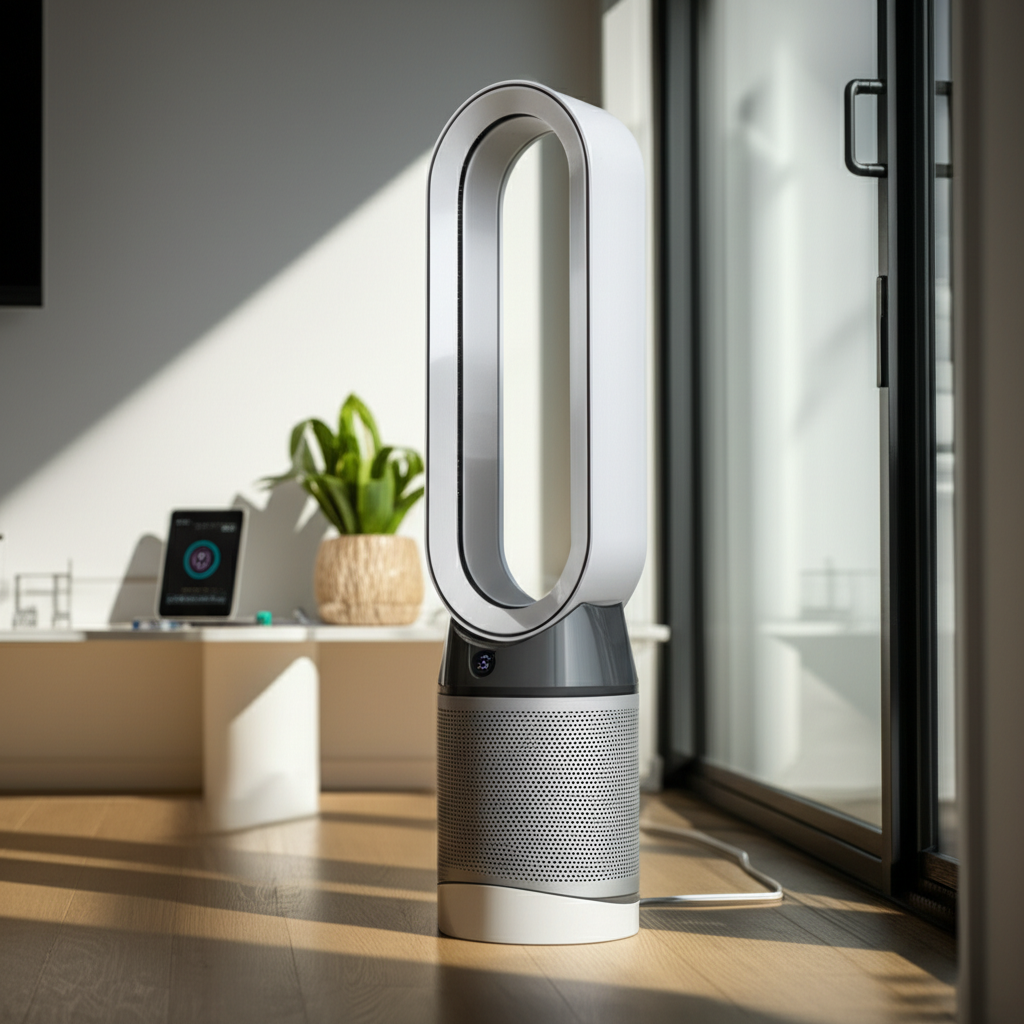
Dyson’s filtration technology is central to its air purifier fan’s effectiveness. The system is designed to trap even the smallest airborne contaminants, ensuring they are not recirculated. This thorough capture process is what sets premium air purifiers apart from basic models.
The sealed nature of the filtration system is a key differentiator. It means that once pollutants are captured, they stay captured. This prevents secondary contamination and ensures that the air leaving the device is genuinely cleaner.
The Role of Activated Carbon in Air Purification
Activated carbon is a vital component in many air purifiers, and Dyson units are no exception. This porous material has a large surface area, allowing it to adsorb gases, odors, and harmful VOCs that HEPA filters cannot remove. Think of it as a sponge for smells and chemical fumes.
By combining HEPA filtration for particles with activated carbon for gases, Dyson purifiers offer a comprehensive approach to improving indoor air quality. This is particularly beneficial in homes where cooking odors, pet smells, or off-gassing from furniture might be a concern.
Design and Build Quality: A Dyson Signature
Dyson products are known for their distinctive, modern aesthetic, and their air purifier fans are no exception. They often feature a bladeless design, which not only looks futuristic but also contributes to safety, especially in households with children or pets. The sleek, minimalist look means they can blend seamlessly into most home decor.
Beyond aesthetics, the build quality is generally robust. Materials used are high-grade, and the engineering feels precise. This attention to detail extends to the user interface and overall durability, suggesting a product built to last.
The Bladeless Technology Explained
Dyson’s signature bladeless technology, often referred to as Air Multiplier™ technology, is a key innovation. Instead of spinning blades, it uses an impeller to draw air in and then amplifies it through a narrow aperture around the loop amplifier. This creates a powerful, smooth, and consistent stream of air.
This design not only looks unique but also offers practical benefits. It makes cleaning easier, as there are no grilles or blades to trap dust. Furthermore, the smooth airflow is often perceived as less disruptive than the choppy airflow from traditional fans.
Materials and Durability of Dyson Units
When you invest in a Dyson product, you expect a certain level of quality, and their air purifier fans typically deliver. The plastics used are often dense and smooth, giving a premium feel. Metal accents are sometimes incorporated, adding to the perceived durability.
The engineering behind these devices is complex, yet they are designed for everyday use. While any electronic device can malfunction, Dyson products generally hold up well over time, contributing to their long-term value proposition.
Performance: Purification and Cooling Capabilities
The core function of a Dyson air purifier fan is its ability to both purify the air and provide cooling. The effectiveness of its purification is typically measured by its ability to remove pollutants, while its cooling performance is judged by its ability to circulate air and provide a noticeable cooling effect.
In terms of purification, Dyson units generally perform well in independent tests, effectively capturing a wide range of airborne particles. The cooling aspect, while not equivalent to a dedicated air conditioner, provides a refreshing breeze, especially in warmer months.
Air Purification Effectiveness: Real-World Impact
Independent testing and user feedback often highlight Dyson air purifier fans’ strong performance in capturing airborne particles. Studies have shown their ability to significantly reduce common indoor allergens like pollen and dust mites. For individuals suffering from allergies or asthma, this can translate into noticeable relief.
The consistent airflow ensures that purified air is circulated throughout the room, rather than just around the device. This creates a more uniform environment of cleaner air, which is crucial for effective purification in a living space.
Cooling Performance: A Gentle Breeze
While Dyson air purifier fans are not air conditioners, they do provide a significant cooling effect through air circulation. The Air Multiplier™ technology creates a powerful, steady stream of air that can make a room feel considerably cooler and more comfortable.
This fan function is particularly useful during transitional weather or in rooms where a full air conditioning unit might be overkill. It offers a refreshing breeze without the energy consumption of an AC.
Smart Features and Connectivity
Many modern Dyson air purifier fans come equipped with smart features, enhancing their usability and integration into a connected home. These often include Wi-Fi connectivity, allowing users to control the device remotely via a smartphone app. This app provides real-time air quality monitoring and control over various settings.
The integration of smart technology aims to make managing your home’s air quality more convenient and data-driven. You can schedule operation, adjust fan speeds, and even track historical air quality data, all from your phone.
The Dyson Link App: Control and Monitoring
The Dyson Link app is the central hub for managing your Dyson air purifier fan. It provides a user-friendly interface to monitor indoor and outdoor air quality in real-time, view historical data, and adjust settings like fan speed, oscillation, and sleep timers.
This app is invaluable for understanding your home’s air quality patterns. You can see when pollution levels are highest and how your Dyson unit is working to improve them. It also allows for remote control, so you can turn on your purifier before you even get home.
Voice Control and Compatibility
For added convenience, many Dyson air purifier fans are compatible with voice assistants like Amazon Alexa and Google Assistant. This allows you to control basic functions—such as turning the device on or off, adjusting the fan speed, or activating sleep mode—using simple voice commands.
Integrating with smart home ecosystems makes managing your air quality effortless. You can ask your voice assistant to “turn on the Dyson purifier” or “set the fan speed to 5” without needing to pick up your phone or approach the device.
User Experience and Ease of Use
Dyson products are generally designed with user-friendliness in mind, and their air purifier fans are no exception. Setup is typically straightforward, and daily operation is intuitive, often controlled via a remote or the accompanying app. The focus is on providing effective air purification without unnecessary complexity.
Maintenance is also a consideration, and Dyson has aimed to simplify this. Filter replacement is usually a simple process, and the bladeless design means less dusting compared to traditional fans.
Setting Up Your Dyson Air Purifier Fan
Getting started with a Dyson air purifier fan is usually a hassle-free process. Most models come with the filters pre-installed or ready for easy insertion. The initial setup often involves plugging in the device, connecting it to your Wi-Fi network via the Dyson Link app, and following a few on-screen prompts.
The app guides you through the process, making it accessible even for those who aren’t particularly tech-savvy. Within minutes, your purifier should be up and running, ready to start cleaning your air.
Daily Operation and Maintenance
Once set up, daily operation is largely automated. The device can be set to automatically detect and react to changes in air quality. You can also manually select modes, fan speeds, and oscillation settings through the remote control or the app.
Maintenance primarily involves replacing the filters periodically. The Dyson Link app will notify you when the filters need changing, and the process itself is designed to be quick and easy, usually involving a simple click-and-release mechanism.
Comparing Dyson Air Purifier Fans: Models and Features
Dyson offers a range of air purifier fan models, each with slightly different features and capabilities. Understanding these variations is key to choosing the best fit for your needs and budget. Common distinctions include heating capabilities, coverage area, and specific sensor technologies.
While all Dyson purifiers share the core technology of HEPA and activated carbon filtration, some advanced models may offer enhanced sensing for more detailed air quality reporting or different oscillation patterns for wider air distribution.
Key Dyson Air Purifier Fan Models
Dyson’s product line evolves, but historically, models like the Pure Cool™ series have been popular. These often come in desk and tower formats, catering to different room sizes. Some models integrate heating functions, offering year-round comfort and purification.
When comparing models, look at the CADR (Clean Air Delivery Rate), which indicates how quickly the purifier can clean a room. Also, consider the specific sensors included (e.g., PM2.5, VOC, NO2) and the type of filter system.
Feature Comparison Table
To illustrate the differences, here’s a simplified comparison of potential features across Dyson air purifier fan models:
| Feature | Dyson Pure Cool™ Desk | Dyson Pure Cool™ Tower | Dyson HP07 (Hot+Cool™) |
| :——————— | :————————— | :————————— | :————————– |
| Primary Function | Purify & Cool | Purify & Cool | Purify, Cool & Heat |
| Room Coverage | Smaller rooms, personal space | Medium to large rooms | Medium to large rooms |
| Filtration | HEPA + Activated Carbon | HEPA + Activated Carbon | HEPA + Activated Carbon |
| Smart Connectivity | Yes (Dyson Link App) | Yes (Dyson Link App) | Yes (Dyson Link App) |
| Air Quality Sensors | Basic | Basic | Advanced (PM2.5, VOC, etc.) |
| Noise Level (Max) | Moderate | Moderate | Moderate |
| Price Point | Lower | Mid-range | Higher |
Note: Specific features and model availability can vary by region and over time. Always check Dyson’s official website for the most current information.
This table highlights how different models cater to varying needs and budgets, offering a spectrum of functionalities from basic purification and cooling to all-season climate control.
Pros and Cons of Dyson Air Purifier Fans
Like any product, Dyson air purifier fans have their strengths and weaknesses. Understanding these can help you weigh the benefits against the costs and determine if it’s the right investment for your home.
Advantages:
Effective Purification: High-quality HEPA and activated carbon filters capture a wide range of pollutants.
Dual Functionality: Combines air purification with effective cooling, and some models offer heating.
Innovative Design: Bladeless technology is safe, easy to clean, and aesthetically pleasing.
Smart Features: App control and voice assistant compatibility offer convenience and detailed monitoring.
Sealed System: Ensures pollutants are trapped and not released back into the air.
Disadvantages:
High Price Point: Dyson products are a significant investment compared to many other air purifiers.
Filter Replacement Cost: Ongoing cost of replacing filters can add up over time.
Cooling is Fan-Based: Not as powerful as a dedicated air conditioner for significant temperature reduction.
* Noise Level: While generally quieter than traditional fans, they can still produce noticeable noise at higher settings.
Are There More Affordable Alternatives?
While Dyson offers premium features and performance, its price tag can be a barrier for many. Fortunately, the market for air purifiers is vast, and numerous brands offer effective solutions at more accessible price points. For instance, brands like Coway, Levoit, and Blueair are frequently cited for their strong performance in independent reviews and consumer reports.
These alternatives often feature multi-stage filtration systems, including HEPA and activated carbon filters, and can be highly effective at removing allergens, dust, and odors. Some also offer smart features and quiet operation.
Exploring Competitor Brands and Technologies
When looking at alternatives, consider brands that consistently receive positive ratings for their purification capabilities. Coway’s Airmega series, for example, is often praised for its robust filtration and real-time air quality monitoring. Levoit offers a range of budget-friendly options that still provide reliable HEPA filtration. Blueair units are known for their quiet operation and energy efficiency.
Many competitors use similar filtration technologies, such as True HEPA filters and activated carbon. The key is to find a model that matches your room size requirements and filtration needs.
Final Verdict: Is a Dyson Air Purifier Fan Essential?
After reviewing its technology, performance, and user experience, a Dyson air purifier fan is a high-performing, feature-rich device that significantly contributes to cleaner indoor air and provides cooling comfort. For individuals with severe allergies, respiratory sensitivities, or a strong desire for integrated smart home technology and premium design, it can certainly feel essential.
However, “essential” is subjective and depends heavily on your specific needs and budget. If your primary concern is basic air purification and you’re on a tighter budget, more affordable options may suffice. But if you value cutting-edge technology, a sleek design, and the convenience of dual functionality, a Dyson air purifier fan represents a worthwhile investment in your home’s health and comfort.
Frequently Asked Questions
What is the main benefit of a Dyson air purifier fan?
The main benefit is its dual functionality, effectively purifying your home’s air while also providing cooling airflow, all within a sleek, modern design. It captures a wide range of pollutants and circulates clean, fresh air.
How often do Dyson air purifier fan filters need to be replaced?
Dyson air purifier fan filters typically need replacement every 12 months, depending on usage and air quality. The Dyson Link app will notify you when it’s time for a change.
Can a Dyson air purifier fan replace a standalone air conditioner?
No, a Dyson air purifier fan is not a direct replacement for an air conditioner. While it provides cooling through air circulation, it doesn’t lower the ambient temperature of a room in the same way an AC does.
Are Dyson air purifier fans noisy?
Dyson air purifier fans are designed to be relatively quiet, especially at lower fan speeds. However, like most fans, they will produce more noise at higher settings when working to circulate more air.
Is the Dyson Link app necessary to use the air purifier fan?
While you can operate the Dyson air purifier fan using its remote control or onboard controls, the Dyson Link app unlocks its full potential, including remote control, detailed air quality monitoring, and scheduling.
How effective are Dyson air purifiers against viruses and bacteria?
Dyson air purifiers with HEPA filters are highly effective at capturing airborne particles, including viruses and bacteria that are larger than 0.3 microns. Their sealed systems ensure these captured particles remain trapped.
Can I use a Dyson air purifier fan in a large room?
Dyson offers various models designed for different room sizes. Larger models, like the tower versions, are well-suited for medium to large rooms, while desk models are better for smaller spaces or personal use.
