Best Window Cleaning Robots (2026): 7 Robot Window Cleaners Compared

Quick answer
The ECOVACS WINBOT W2S Pro is our top pick for most homes: 10,000Pa suction, a triple-spray wet wipe, TruEdge 2.0 edge brushes and a 10-stage safety system, in a newer model. If you want the robot to clean its own pads, the WINBOT W3 Omni adds a station that washes the pads with 16 high-pressure nozzles. For a scraper finish like a squeegee, the HOBOT SP10 iScraper sprays, wipes and then scrapes away water.
HomeHygia is reader-supported. When you buy through links on this page, we may earn a small commission from Amazon at no extra cost to you.
Window cleaning robots stick to glass with suction, spray it with water or cleaner, and wipe it with a microfiber pad while mapping a path across the pane. They’re most useful for big glass walls, floor-to-ceiling windows, glass balcony doors and windows that are awkward or unsafe to reach.
They don’t replace a squeegee for every job. A robot needs a minimum glass area, it is attached by a safety tether, and you still move it from pane to pane. But for large panes or high glass you can’t easily reach, they save a lot of time and ladder work.
We compared seven popular robots using each maker’s Amazon listing, looking at suction, spray system, navigation, edge cleaning, safety features and extras like scrapers and self-cleaning stations. Performance and safety claims come from the makers. We haven’t tested these robots ourselves.
Our picks at a glance
| Product | Model | Best for | Suction | Buy |
|---|---|---|---|---|
 | ECOVACS WINBOT W2S PRO Window Cleaning Robot | Best overall window cleaning robot | 10,000Pa | Check price |
 | ECOVACS WINBOT W3 OMNI Robot Window Cleaner with Station | Best premium robot with self-cleaning station | Not listed | Check price |
 | HOBOT-SP10 iScraper Window Cleaning Robot | Best for streak-free scraper finish | 6000Pa | Check price |
 | ECOVACS Winbot W1 Pro Window Cleaning Robot | Best value from a major brand | 2,800Pa | Check price |
 | HOBOT-2S Window Cleaning Robot with Ultrasonic Spray | Best for large commercial-style glass | 7 kg ascending power (maker) | Check price |
 | HOBOT-298 Window Cleaning Robot with Ultrasonic Spray | Best budget HOBOT | Vacuum (not rated in Pa) | Check price |
 | Tosima WA9C Pro Window Cleaning Robot | Best budget robot with backup battery | 2600-3200Pa | Check price |
The best window cleaning robots, reviewed
1. Best overall window cleaning robot
ECOVACS WINBOT W2S PRO Window Cleaning Robot
| Suction | 10,000Pa |
| Spray | 3 nozzles |
| Navigation | WIN-SLAM 4.0 |
| Edges | TruEdge 2.0, 4 brushes |
| Safety | 10-stage |
| Model | WINBOT W2S PRO |
The WINBOT W2S Pro is ECOVACS’ newer mainstream window robot, and it brings high-end features at a more reachable level than the W3 Omni. It uses 10,000Pa suction to hold a secure grip, backed by a 10-stage safety system that ECOVACS says combines six hardware-based fall-protection measures with three intelligent safeguards.
Cleaning is wet wiping. Three precision nozzles spray a fine mist to loosen dust, pollen, water spots, fingerprints, smudges and pet marks, and an ultra-fine microfiber pad lifts the dirt away. ECOVACS’ TruEdge 2.0 uses four edge brushes and high-density felt bristles to clean closer to frames and corners, leaving less detail work for you.
WIN-SLAM 4.0 plans the path and detects boundaries and obstacles. You can choose from several modes, including Fast, Thorough, Edge and Heavy-Duty, to match how dirty the glass is.
What works
- 10,000Pa suction
- Triple-spray wet wiping
- TruEdge 2.0 edge brushes
- 10-stage safety system
What to watch
- Pads need hand washing
- Still moved pane to pane
- Newer model, fewer user reports
2. Best premium robot with self-cleaning station
ECOVACS WINBOT W3 OMNI Robot Window Cleaner with Station
| Suction | Not listed |
| Spray | 3 wide-angle nozzles |
| Navigation | WIN-SLAM 5.0 |
| Station | Vortex Wash, 16 nozzles |
| Safety | 12-level |
| Model | WINBOT W3 OMNI |
The W3 Omni is ECOVACS’ flagship window robot, and its big idea is the station. After cleaning, the station washes the mop pads automatically using what ECOVACS calls Vortex Wash, with 16 high-pressure nozzles cleaning the pads in about a minute. That removes the dirtiest part of using a window robot: rinsing grimy pads by hand.
On the glass, the triple-nozzle wide-angle spray system loosens dirt for the wet pad, and TruEdge technology lowers a scrubber along edges that spins at 200 RPM into corners, then retracts to avoid spreading dirt. WIN-SLAM 5.0 navigation offers dynamic obstacle avoidance and Fast, Intensive and Zone cleaning modes.
ECOVACS lists a 12-level protection system. The trade-off is size and cost: the station takes up space, so it makes the most sense in a home with lots of large glass.
What works
- Station washes pads automatically
- TruEdge 200 RPM edge scrubber
- WIN-SLAM 5.0 navigation
- 12-level protection
What to watch
- Premium price
- Station needs storage space
- Overkill for a few small windows
3. Best for streak-free scraper finish
HOBOT-SP10 iScraper Window Cleaning Robot
| Suction | 6000Pa |
| Spray | Dual pressurized |
| Scrapers | Dual glide |
| Angle | 7° to 100° |
| Control | App + remote |
| Model | HOBOT-SP10 |
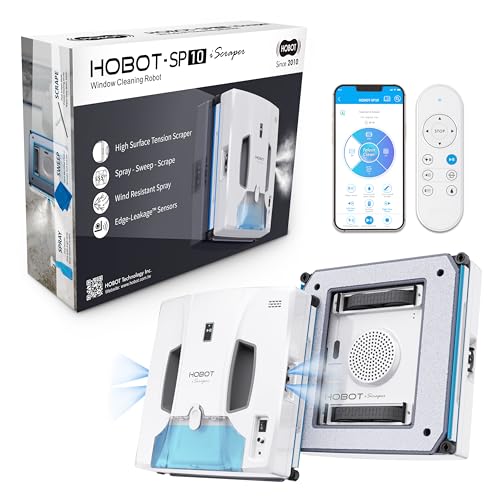
The HOBOT SP10 cleans more like a window washer than most robots. HOBOT calls it SSS: spray water through the nozzles, sweep the glass with a cleaning cloth, then scrape off residual water with dual scrapers. When the robot moves horizontally, it lifts the leading scraper and lowers the trailing one, which HOBOT says removes water without streaks.
Pressurized dual sprays cover an ultra-wide angle and are designed to resist wind for outdoor use. 6000Pa static suction adjusts its grip to subtle variations in the glass, and edge-leakage sensors react to air leaks from window seals, frameless edges or bumps against frames.
Uniquely, HOBOT says it works on reclined glass from 7° to 100°, including greenhouse roofs and solar panels. It is controlled by app or remote and suits framed and frameless glass, indoors or out.
What works
- Spray, sweep and scrape
- Dual glide scrapers
- Works on reclined glass and solar panels
- App and remote control
What to watch
- 6000Pa, lower than W2S Pro
- Scrapers add parts to clean
- Learning curve
4. Best value from a major brand
ECOVACS Winbot W1 Pro Window Cleaning Robot
| Suction | 2,800Pa |
| Spray | Dual cross spray |
| Navigation | WIN SLAM 3.0 |
| Reservoir | 60 ml |
| Modes | Quick, deep, spot |
| Model | W1PRO |
The Winbot W1 Pro is an older ECOVACS model that remains a solid value. It holds on with 2,800Pa suction and uses cross water spray in two directions to keep the pad evenly damp, which ECOVACS says dissolves stubborn stains.
WIN SLAM 3.0 path planning uses a forward-reverse motion in three modes: quick cleaning, deep cleaning and spot stain removal. A high-precision coupling sensor detects edges within 0.02 seconds, which helps on frameless glass. The 60 ml reservoir means fewer refills.
When it finishes, position memory returns the robot to its starting point so you can easily retrieve it. ECOVACS lists an internal drive system for non-slip movement and power failure protection.
What works
- Trusted brand at lower cost
- Dual cross spray
- Edge detection for frameless glass
- Returns to start point
What to watch
- 2,800Pa, much lower than newer models
- No edge brushes
- Older navigation
5. Best for large commercial-style glass
HOBOT-2S Window Cleaning Robot with Ultrasonic Spray
| Suction | 7 kg ascending power (maker) |
| Spray | Ultrasonic mist |
| Cloth | 9.5 × 9.5 in |
| Tanks | Dual, replaceable |
| Warranty | 1 year |
| Model | Hobot2s |
The HOBOT-2S uses an ultrasonic water spray that turns water into a dense mist, which HOBOT says cleans without leaving water stains. A powerful vacuum, listed as 7 kg ascending power, attaches it to the glass.
It moves on caterpillar treads with an auto-adjustable pneumatic pad that balances driving force and cloth pressure. AI-smart route planning and auto-edge detection navigate the window, and an edge-leakage sensor detects air leaks at frameless edges. The large 9.5 × 9.5 inch cloth reaches deep into corners.
Dual replaceable water tanks mean that if the nozzle clogs, you can swap the whole tank with a standard screwdriver. It offers app or remote control, voice prompts, three automatic programs and over-the-air updates, with a long power cord and extension for restaurants and offices as well as homes.
What works
- Ultrasonic mist spray
- Large 9.5 in cloth
- Dual replaceable tanks
- App, remote and voice prompts
What to watch
- Corded operation
- Older design
- Square body may miss rounded corners
6. Best budget HOBOT
HOBOT-298 Window Cleaning Robot with Ultrasonic Spray
| Suction | Vacuum (not rated in Pa) |
| Spray | Ultrasonic |
| Cloth | 9.5 × 9.5 in |
| Minimum glass | 13 × 13 in |
| Warranty | 1 year |
| Model | Hobot-298 |
The HOBOT-298 shares much of the 2S design: ultrasonic water spray to dissolve dust without watermarks, a vacuum that holds it to the surface, an auto-adjustable pneumatic pad, caterpillar treads, AI-smart route planning and a 9.5 × 9.5 inch cleaning cloth.
It has a single replaceable water tank and can be controlled from a smartphone app or remote. HOBOT notes that it works with the power cord only, so keep the extension cord tidy and the safety tether attached.
Read HOBOT’s limits before you buy: it should not be used on frames with rounded edges, and the minimum cleaning surface is 13 × 13 inches. For standard rectangular windows and glass doors, it’s an affordable entry point.
What works
- Ultrasonic spray
- Large cleaning cloth
- App and remote
- Lower cost
What to watch
- Not for rounded frames
- Minimum 13 × 13 in glass
- Corded only
7. Best budget robot with backup battery
Tosima WA9C Pro Window Cleaning Robot
| Suction | 2600-3200Pa |
| Spray | 4 nozzles |
| Modes | 6 incl. N, Z, manual |
| Safety | Backup battery, drop sensor |
| Control | Remote |
| Model | WA9C PRO |
The Tosima WA9C Pro is a lower-cost robot with a 4-nozzle dual spray system, two nozzles on each side, which Tosima says purges air from the water lines for an even spray. Suction ranges from 2600 to 3200Pa, with an air pressure monitor and a bottom drop sensor.
For safety, it has power failure protection: if the power cuts out, an internal battery keeps the robot attached to the window for a period while it alerts you. Tosima lists six cleaning modes, including N-shape vertical, Z-shape horizontal and a manual mode you steer with the remote.
The remote lets you toggle between regular and large spray volumes. It’s a reasonable choice if you want a basic robot for mirrors, glass doors and high windows without paying for an ECOVACS.
What works
- 4-nozzle dual spray
- Backup battery for power cuts
- Six modes including manual
- Remote spray control
What to watch
- Lower suction (2600-3200Pa)
- No edge brushes
- Lesser-known brand
How to choose a window cleaning robot
Window robots differ most in how they grip, how they spray, and how well they handle edges.
1. Suction and safety
Higher suction means a firmer grip, especially on textured or slightly dusty glass. Look for layered safety: a safety tether, power failure protection or a backup battery, and edge or air leak sensors. Always attach the tether, even indoors.
2. Spray system
Automatic spray keeps the pad damp so it doesn’t just drag dry dust. Multi-nozzle and ultrasonic systems spread a finer, more even mist. Use plain water or a gentle glass cleaner; harsh chemicals can damage pads and seals.
3. Edge cleaning
Round and square robots both leave a margin at the frame. Edge brushes (like ECOVACS TruEdge) and scrapers (like the HOBOT SP10) help close that gap. Expect to touch up corners with a cloth.
4. Navigation
Smart path planning reduces missed strips and wasted passes. Modes like spot, edge or heavy-duty let you match the job.
5. Minimum window size and frames
Check the minimum glass size and frame type. Small divided panes and rounded frames are poor fits for most robots.
6. Pad cleaning
Pads get dirty quickly. Self-cleaning stations like the W3 Omni’s save effort; otherwise, keep spare pads and wash them after each session.
How to get the best results
- Dust heavy grime off first. A robot wipes, it doesn’t scrub caked dirt or bird droppings.
- Attach the safety tether to something solid inside the room.
- Start with a damp, clean pad. Dry pads can slip; filthy pads smear.
- Use a gentle cleaner. Plain water is often enough. If you use a product, look for the EPA Safer Choice label.
- Do the outside on a calm, overcast day. Wind and hot sun cause drips and streaks.
- Finish corners by hand with a microfiber cloth or a small squeegee.
Robot vs other window tools
Robots shine on big, high or hard-to-reach glass. For quick touch-ups and small panes, a handheld window vacuum is faster; see our guide to the best window vacuum cleaners. For sticky film on glass and tracks, a steam cleaner helps; see the best steam cleaners for windows. If you like the idea of robot help on the floor too, our guide to the best robot vacuum mops is a good next read.
FAQ
Do window cleaning robots really work?
Yes, on large flat glass they wipe well and save a lot of time and ladder work. They leave a small margin at the edges and struggle with heavy grime, so most people still do quick touch-ups by hand.
Is a window cleaning robot safe on high windows?
Robots use suction, sensors and a safety tether, and many have backup batteries for power cuts. Always attach the tether and follow the maker’s instructions, especially on the outside of upper-floor windows.
Can a window cleaning robot clean both sides of the glass?
No. It cleans one side at a time. To clean the outside, you place it on the outer surface, which is only practical where you can reach safely or the window opens.
What cleaner should I use in a window robot?
Plain water works for most dust and fingerprints. A small amount of gentle glass cleaner can help with film, but avoid harsh chemicals that can damage the pad or seals. Check the manual.
Can window robots work on frameless glass?
Many can. Look for edge detection or edge-leakage sensors, like on the WINBOT W1 Pro and HOBOT models, which help the robot recognize frameless edges.
Bottom line
For most homes, the ECOVACS WINBOT W2S Pro is the best window cleaning robot, with strong suction, triple spray and edge brushes. Choose the WINBOT W3 Omni for a self-cleaning station, the HOBOT SP10 for a scraper finish and reclined glass, and the Winbot W1 Pro for value.