
What Happens If a Vacuum Filter Is Clogged?

Quick Answer
When a vacuum filter becomes clogged, airflow through the machine drops. That can cause weak suction, extra heat, changed motor noise, poor pickup, and sometimes automatic shutdown. A heavily blocked filter may also contribute to long-term vacuum damage if you keep using the machine without fixing the airflow restriction. The EPA’s indoor particulate matter guidance also explains why controlling household dust matters.
Common effects of a clogged vacuum filter
- Weak suction: Restricted airflow reduces the vacuum’s ability to pick up dirt efficiently.
- Extra heat: The vacuum may run warmer because less air moves through its airflow system.
- Changed sound: You may hear a strained, higher-pitched, or unusual motor sound.
- Sudden shutdown: Some models may switch off when overheating protection activates.
- Poor filtration: An overloaded, damaged, or incorrectly fitted filter may not perform as intended.
- Possible damage: Continuing to vacuum with severe airflow restriction may put unnecessary stress on the machine.
What to check first
- Switch the vacuum off, disconnect power, empty the bin or check the bag, inspect the hose, and then check the filter according to your owner’s manual.
A clogged vacuum filter can make a perfectly good cleaner feel worn out. I’ve seen weak suction blamed on motors when the real problem was simply restricted airflow.
As of 2026, my troubleshooting rule is still simple: check the easy airflow problems before assuming the vacuum needs repair. Here’s what a clogged filter does, how to recognize it, and when cleaning is no longer enough.
In This Guide
- What happens when a vacuum filter gets clogged?
- How can you tell if your vacuum filter is clogged?
- Why does a clogged filter reduce vacuum suction?
- Is the filter clogged, or is something else blocking airflow?
- What should you do when a vacuum filter is clogged?
- How can you stop a vacuum filter from clogging quickly?
- Frequently asked questions
What Happens When a Vacuum Filter Gets Clogged?
A clogged filter restricts the air moving through your vacuum. That restriction can affect suction, cooling, cleaning performance, and the way the motor sounds.
A clogged vacuum filter is filter media loaded with enough dust, fibers, hair, or fine debris to restrict normal airflow. Some dust on the filter is expected, but a dense buildup becomes a problem.
1. Suction becomes weaker
Reduced suction is usually the first thing people notice. Dirt may stay on carpets or floors even after several passes.
The vacuum may still sound powerful. However, less useful airflow is reaching the floor head.
- Carpets: Hair and crumbs may require repeated passes.
- Hard floors: Debris may be pushed around instead of collected.
- Attachments: Crevice tools may feel noticeably weaker.
2. The vacuum may run hotter
Airflow often plays an important role in moving heat through a vacuum cleaner. A severe restriction can therefore make the machine feel hotter than usual.
Heat alone doesn’t prove the filter is responsible. A blocked hose, packed bin, tangled brush roll, or internal problem can create similar symptoms.
3. The motor sound may change
I pay attention whenever a familiar vacuum suddenly sounds different. A clogged airflow path can produce a strained or unusually high-pitched sound.
Stop and inspect the machine instead of trying to finish the room. Continuing to run it won’t clear a blocked filter.
4. Some vacuums may shut themselves off
Certain vacuum cleaners contain thermal protection that stops the motor when temperatures rise too far. If your vacuum repeatedly shuts down, restricted airflow is one possible cause.
Let the machine cool and follow its manual before restarting it. Don’t repeatedly reset a vacuum that keeps overheating.
5. Filtration performance can suffer
Filters are part of the vacuum’s dust-management system. A damaged, overloaded, wet, or badly seated filter may not perform the way its manufacturer intended.
The EPA notes that household dust can include pollen, mold spores, pet dander, dust mites, hair, and other particles. That’s one reason I take filter condition seriously rather than treating it only as a suction issue.
Section Takeaway: A clogged filter is mainly an airflow problem, but that airflow restriction can affect suction, temperature, motor behavior, and filtration at the same time.
How Can You Tell If Your Vacuum Filter Is Clogged?
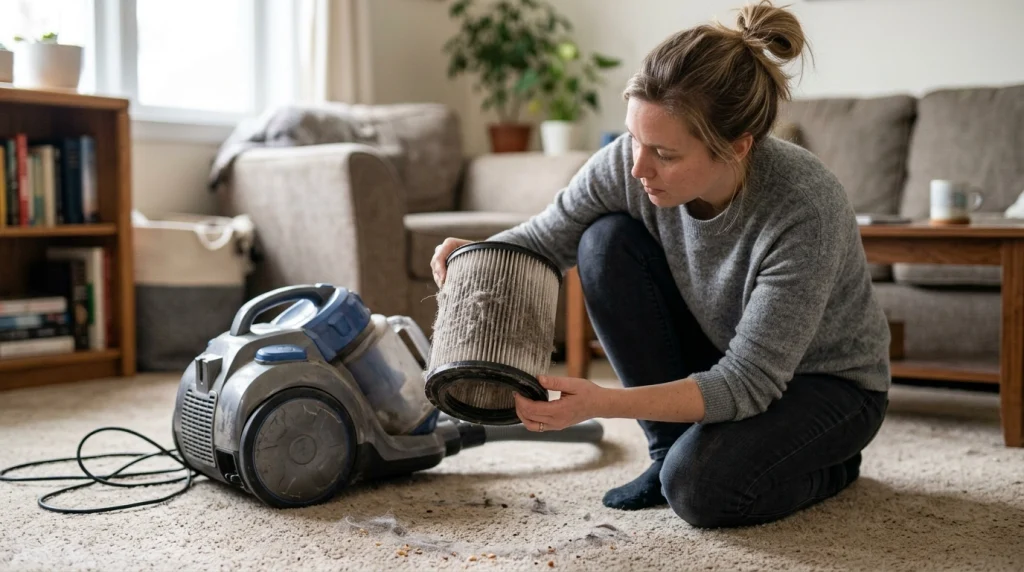
The strongest clue is a combination of weak performance and visible filter buildup. Don’t rely on color alone because used filters often become discolored before they are truly blocked.
Look for several symptoms together
- Persistent weak suction: Pickup stays poor after the bin is emptied.
- Heavy dust coating: Pleats, foam, mesh, or filter surfaces look packed.
- Extra warmth: The vacuum becomes hotter during ordinary use.
- Different motor pitch: The machine sounds strained or unusually sharp.
- Frequent stopping: The vacuum shuts down and works again after cooling.
- Poor debris pickup: Dirt requires noticeably more passes than normal.
A quick visual inspection often tells me a lot. I once checked a bagless vacuum that had almost no carpet pickup even after its bin was emptied.
The pleated filter looked like a solid gray surface instead of visible pleats. Once the approved maintenance was completed, airflow improved without touching the motor.
Don’t forget the dust container
A full bin or bag can mimic a dirty filter. Check it before taking the vacuum apart.
Bagless models often have a maximum-fill line. Staying below that line can help the machine maintain its intended airflow.
Why Does a Clogged Filter Reduce Vacuum Suction?
A vacuum depends on moving air through an intake, collection system, filter, and exhaust path. When the filter becomes restrictive, less air can move through that path efficiently.
Think of the filter as a breathable barrier. Dust must be captured without blocking the passage of air the vacuum needs to operate.
Fine dust can block filters quickly
Large crumbs usually settle in the bin. Fine material can travel farther through the machine and accumulate on filter media.
- Drywall and sanding dust
- Fireplace ash
- Fine household dust
- Pet dander and hair fragments
- Carpet fibers and lint
- Powdery debris
A standard household vacuum may not be suitable for large amounts of construction dust or other specialized debris. Check the manufacturer’s approved uses before tackling unusual material.
HEPA doesn’t mean maintenance-free
HEPA stands for high-efficiency particulate air. A HEPA-equipped vacuum still needs correct filter installation and routine maintenance.
The National Institute of Environmental Health Sciences includes HEPA-filtered vacuuming among its household dust-mite reduction suggestions. That doesn’t mean every HEPA vacuum performs identically or that a filter alone determines total machine performance.
Seals, airflow design, filter condition, and correct installation all matter. Follow your vacuum manufacturer’s instructions rather than assuming every HEPA-style filter can be treated the same way.
Section Takeaway: Suction falls because the vacuum cannot move air through a heavily loaded filter as freely as intended. Fine dust often causes faster filter loading than ordinary larger debris.
Is the Filter Clogged, or Is Something Else Blocking Airflow?
A dirty filter isn’t the only cause of weak suction. I troubleshoot the entire airflow path before buying parts.
This comparison can help narrow down the problem.
| Possible Problem | Typical Clue | First Check |
|---|---|---|
| Clogged filter | Weak suction plus heavy dust buildup on filter media | Inspect filter with power disconnected |
| Full bin or bag | Performance improves after emptying or replacing it | Check fill level |
| Blocked hose | Little airflow at the hose or attachment | Inspect hose and wand |
| Tangled brush roll | Poor carpet pickup or brush-roll movement | Check for wrapped hair and thread |
| Blocked floor head | Suction exists at hose but not at floor intake | Inspect intake channels |
| Damaged seal or filter | Air leaks, dust escape, or poor fit | Inspect seals and filter edges |
Try the simplest checks first
- Switch off and unplug the vacuum.
- Empty the dust bin or inspect the bag.
- Check the hose and wand for visible blockages.
- Inspect the floor head and brush roll.
- Remove and inspect the filter as directed by the manual.
- Look for damaged seals or incorrectly fitted parts.
If airflow returns after one of these checks, you’ve probably found the restriction. If nothing changes, the problem may be deeper inside the machine.
Expert Alert: Stop using the vacuum if you notice a burning smell, sparks, damaged wiring, repeated breaker trips, or liquid inside a dry-vacuum motor area. Have a qualified appliance technician inspect it.
What Should You Do When a Vacuum Filter Is Clogged?
Switch the vacuum off and clean or replace the filter according to its manufacturer instructions. Never assume that a removable filter is washable.
Step 1: Disconnect the power
Unplug a corded vacuum before opening filter compartments. Switch off a cordless model and remove its battery when the design allows safe battery removal.
Step 2: Remove loose debris
Take the filter out carefully. When practical, handle dusty filters outdoors or over a trash container.
Gentle tapping may release loose material on filters whose instructions permit it. Avoid crushing delicate pleats.
Step 3: Confirm whether the filter is washable
This is the step I never guess about. Foam, felt, cartridge, pleated, pre-motor, post-motor, and HEPA filters all vary by model.
- Washable filter: Clean it only by the approved method.
- Non-washable filter: Keep it dry and follow replacement or dry-cleaning instructions.
- Damaged filter: Replace it with the correct compatible part.
- Unknown filter: Check the owner’s manual or manufacturer support information.
Step 4: Let washable filters dry completely
Don’t reinstall a damp filter just because its surface feels dry. Moisture can remain deeper in foam or pleated material.
Use the drying period given for your exact model. Don’t speed drying with heat unless the manufacturer explicitly permits it.
Step 5: Reassemble and test
Reinstall the filter in the correct direction and make sure covers latch properly. Then test suction on a small area.
If airflow remains poor, check the remaining air path again. A second clog may be hiding in the hose, wand, floor head, or intake.
The EPA’s broader indoor air quality resources are also useful when household dust and pollutant control are part of your cleaning goal.
Section Takeaway: Clean a clogged filter only by its approved method, let washable filters dry fully, and replace damaged or permanently loaded filters rather than forcing them back into service.
How Can You Stop a Vacuum Filter From Clogging Quickly?
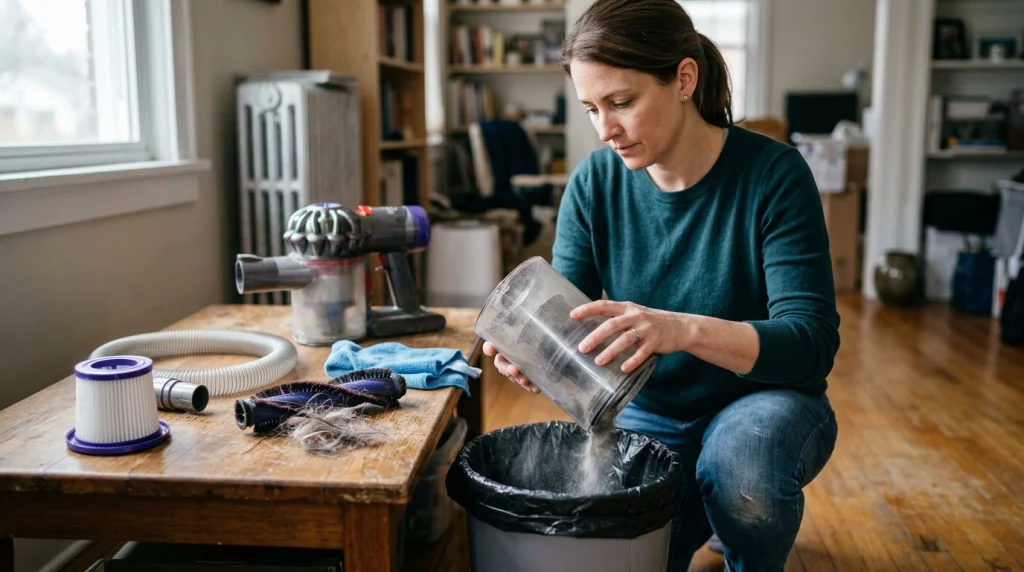
You can’t prevent a vacuum filter from collecting dust. That’s part of its job.
You can, however, reduce unusually fast clogging by managing the whole vacuum instead of focusing on the filter alone.
Empty the bin before it becomes packed
Don’t wait until dirt is compressed against the top of the container. Follow the fill line or manufacturer guidance for your model.
Check the vacuum after heavy fine-dust cleaning
Fine material can load filters much faster than everyday crumbs and hair. Renovation dust deserves particular caution.
If you’re dealing with specialized dust, use equipment intended for that material. Household vacuums aren’t automatically suitable for every cleanup.
Keep the brush roll and air passages clear
Hair around a brush roll and debris inside a hose both interfere with cleaning performance. Regular inspection helps you catch restrictions before they become severe.
- Remove wrapped hair and thread.
- Inspect hose bends for lodged objects.
- Check narrow wand sections.
- Keep intake openings unobstructed.
- Inspect seals when parts are reassembled.
Use the correct replacement filter
A filter that merely fits into the compartment may not be the correct part. Match replacement filters to your exact vacuum model or manufacturer specification.
Don’t run the vacuum without a required filter while another one dries. The filter is part of the machine’s intended airflow and dust-control system.
Control household dust between vacuuming sessions
Vacuuming is only one part of managing indoor dust. The EPA recommends frequent cleaning and notes that damp dusting can help keep settled particles from returning to the air.
For people concerned about dust-mite allergens, NIH guidance also discusses approaches such as damp cleaning and appropriate vacuum filtration. Its broader asthma guidance is available through the NCBI Bookshelf.
Section Takeaway: The best way to reduce repeated filter clogging is to keep the bin, hose, floor head, brush roll, seals, and filter working together as one clear airflow system.
Frequently Asked Questions
Can a clogged vacuum filter damage the motor?
It can contribute to problems when the clog severely restricts airflow and the vacuum keeps running under those conditions. The machine may run hotter or trigger thermal protection. Stop and inspect the airflow system if suction drops or the vacuum becomes unusually hot.
Will a dirty vacuum filter cause loss of suction?
Yes. A filter loaded with enough dust can restrict airflow and reduce pickup strength. However, a full bin, blocked hose, clogged floor head, or damaged seal can cause similar symptoms, so check the entire airflow path.
Can I wash a clogged vacuum filter?
Only if the manufacturer says that exact filter is washable. Some foam, cartridge, pleated, and HEPA filters can be washed, while others must remain dry. Check your model’s manual before putting any vacuum filter in water.
What happens if I keep vacuuming with a clogged filter?
Pickup may continue getting weaker while the vacuum runs hotter or sounds strained. Some machines may eventually shut down from overheating protection. Continued severe airflow restriction may also increase stress on the vacuum.
Can I use my vacuum without the filter while it dries?
Not if the filter is required for normal operation. Wait until the cleaned filter is completely dry and correctly reinstalled, or use an approved spare filter. Follow your manufacturer’s instructions for any model-specific exception.
Why does my new vacuum filter clog so quickly?
Fine dust, pet hair, lint, renovation debris, an overfilled bin, or another airflow blockage may load the filter rapidly. Check what you’re vacuuming and inspect the complete airflow path before assuming the replacement filter is defective.
Should I clean or replace a clogged filter?
Follow the manufacturer’s maintenance instructions. Clean reusable filters by the approved method, but replace filters that are damaged, permanently blocked, deformed, or designated as disposable. The correct choice depends on the filter and vacuum model.
The main takeaway is simple: don’t ignore a vacuum that suddenly loses suction. Switch it off, check the dirt container, hose, floor head, brush roll, and filter, then correct the restriction before continuing.
A few minutes of careful maintenance can often restore normal airflow and prevent a small filter problem from turning into a more frustrating vacuum issue.
