
10 Best Industrial Vacuum Cleaners for Commercial Use in 2026

Commercial cleaning jobs punish weak equipment fast. Carpets in a hotel corridor see foot traffic that a home vacuum never experiences, and a jobsite full of drywall dust or standing water will destroy a machine built for living rooms. Choosing the best industrial vacuum cleaners for commercial use means matching the machine to the mess: routine floor care calls for a different tool than jobsite cleanup involving liquids or heavy debris.
Upright and backpack vacuums dominate daily carpet and hard-floor maintenance in offices, schools, and hospitality settings because they cover ground quickly and hold up to repeated use. Canister vacuums trade some cleaning width for portability, making them useful for stairs, upholstery, and tight spaces. Wet/dry extractors belong in a separate category entirely. They handle liquids, construction debris, and shop waste that would ruin a standard bagged or bagless upright.
The right choice depends on airflow, filtration quality, cord length, and how the machine is actually going to be used day to day, not just its motor wattage. A high-wattage machine with poor airflow design can underperform a lower-wattage unit with better engineering. Noise level and weight also affect operator comfort during long shifts, which matters for retention on cleaning crews.
Best for lightweight daily carpet care: Oreck Commercial XL Vacuum Cleaner
Best for hard-floor cleaning crews: Hoover Commercial Shoulder Vac Pro
Best for shop debris and liquid pickup: Industrial Wet/Dry Vacuum JM773
Best for drywall dust and construction sites: Nilfisk Alto Aero 26 HEPA
Best for high-volume janitorial routes: Sanitaire SC679K Tradition Upright
Best for noise-sensitive commercial spaces: Hoover HushTone Commercial Vacuum
Best for detail work and above-floor cleaning: Hoover Commercial PortaPower Canister
Best for bag-free maintenance budgets: Bissell Commercial BGU1937T Pro Cup
Best for budget-conscious bagged cleaning: BISSELL BigGreen PowerForce BGU1451T
Best for hospitality-grade durability: Windsor Sensor S15
Oreck Commercial XL Vacuum Cleaner

Buy this if daily carpet cleaning across multiple rooms or floors demands a vacuum light enough to carry up stairs without operator fatigue.
Pros
- Weighs just 9 pounds for easy transport
- High-speed brush roll agitates embedded dirt effectively
- Automatic height adjustment simplifies transitions between surfaces
Cons
- Noise level runs louder than some competitors
- Bagged design adds recurring supply cost
- Limited to carpet and hard floor, no wet capability
The 9-pound frame is the story here. Housekeeping staff moving between hotel rooms or office suites notice the difference immediately compared to bulkier uprights. The 35-foot reach (cord plus hose) cuts down on outlet changes during long hallway runs.
Suction stays strong on carpet, and the side brushes catch edge debris that a straight nozzle misses. Reviewers with large households and small cleaning operations report years of reliable service, though a few note the noise and occasional inconsistency on thicker carpet piles.
Hoover Commercial Shoulder Vac Pro

Choose this backpack vacuum for crews covering large square footage of hard flooring where a hose and harness beat pushing an upright.
Pros
- Chiropractor-designed harness reduces strain on long shifts
- 48-foot cord minimizes outlet changes
- HEPA media filtration with no reported suction loss
Cons
- Shoulder strap buckles have been reported to break with heavy use
- 20-pound weight is noticeable on the back over time
- Less effective on deep-pile carpet than upright designs
This is a hard-floor specialist first. Cleaning businesses running hardwood-heavy properties, medical offices, or schools with tile corridors get the most value from the reach and maneuverability. The 60-inch hose lets operators clean baseboards and corners without bending.
The harness genuinely reduces fatigue compared to shoulder-slung canisters, though some units have shown weak point failures at the strap buckles after repeated use. Noise stays low at 66 dBA, a real advantage in occupied buildings.
Industrial Wet/Dry Vacuum JM773
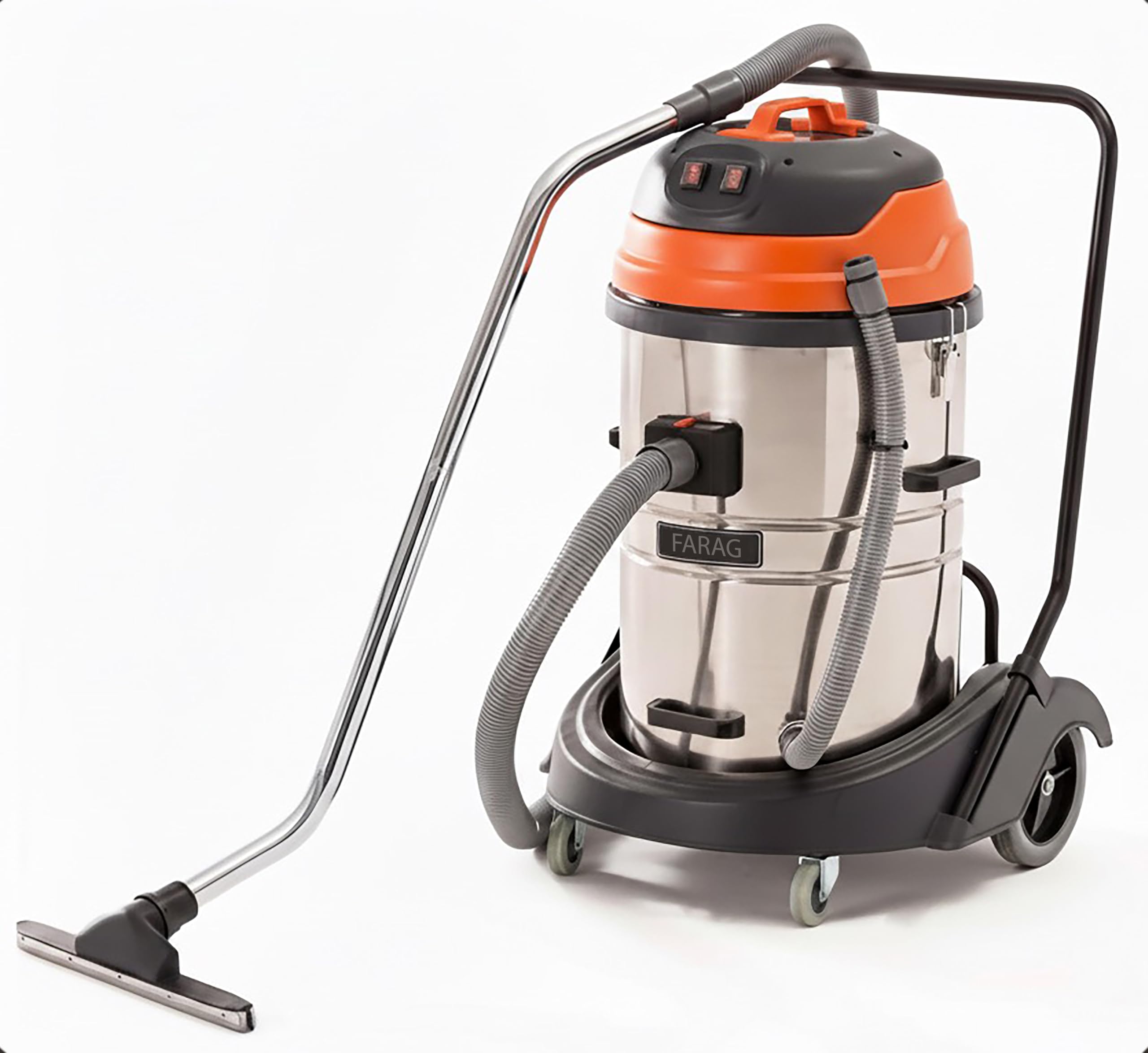
Pick this dual-motor extractor for jobs involving standing water, shop debris, or high-volume dry waste that a standard commercial vacuum cannot touch.
Pros
- Two motors deliver strong combined airflow at 225 CFM
- 21-gallon stainless steel tank handles large volumes
- True wet and dry capability with watershoot drainage
Cons
- Bulky footprint at nearly 38 inches tall
- Cloth filter requires manual cleaning between uses
- Heavier and less maneuverable than upright models
This is a genuine wet/dry machine, not a bagged upright with a damp-mopping claim. Woodworking shops, restoration crews, and maintenance teams dealing with spills or renovation debris get real utility from the tank size and dual-motor airflow.
Owners report years of service, and Farag Janitorial has replaced failed motors under support in at least one documented case. The tradeoff is size and weight; this stays in one area or gets moved on its wheeled base, not carried between floors.
Nilfisk Alto Aero 26 HEPA

Select this contractor-grade extractor for drywall dust and renovation cleanup where certified HEPA filtration and quiet operation both matter.
Pros
- Certified HEPA filtration meets EPA lead-dust requirements
- Tool-start function activates automatically with power tools
- Notably quiet at 64 dB compared to most wet/dry units
Cons
- Smaller 25-liter (7-gallon) capacity than dedicated shop vacuums
- Premium price relative to basic wet/dry models
- Fewer big-box accessory options than mainstream brands
Contractors doing drywall sanding or renovation work value the auto-tool-start feature, which switches the vacuum on whenever a connected power tool runs. That keeps dust contained at the source instead of settling across a room.
The semi-automatic filter cleaning (Push & Clean) extends run time between manual filter taps. Multiple reviewers upgrading from big-box shop vacuums note the quieter operation and better filtration, though the smaller tank means more frequent emptying on large jobs.
Sanitaire SC679K Tradition Upright
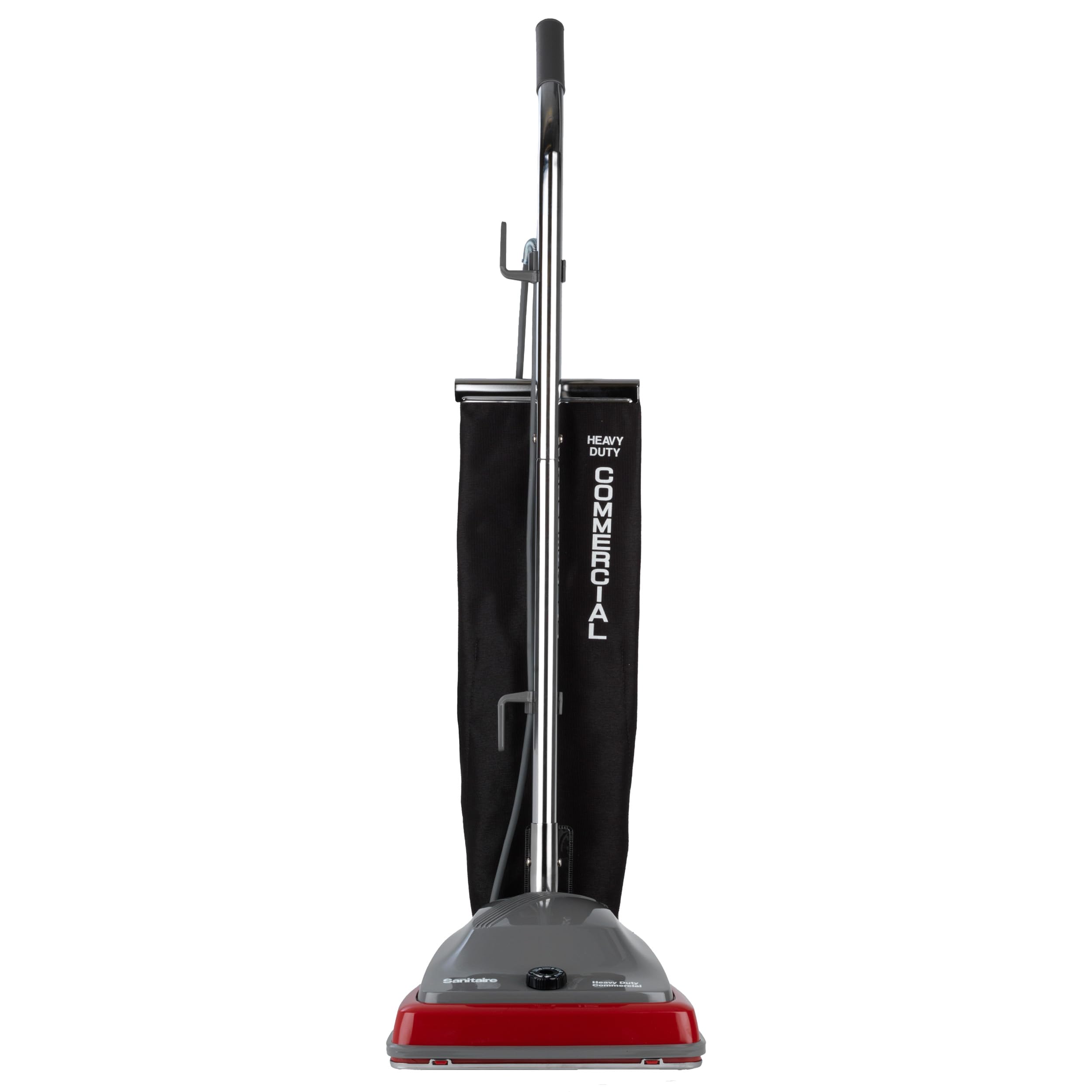
Go with this upright for janitorial accounts that need a straightforward, tool-free-maintenance machine rated for 500 hours of commercial motor life.
Pros
- Rated for 500 hours of commercial-grade motor performance
- Tool-free brush roll and belt replacement
- 30-foot cord covers large rooms without replugging
Cons
- Belt breakage reported by multiple long-term users
- 78 dB noise level is noticeable in occupied spaces
- Bagged design at 18 quarts requires regular restocking
Janitorial contractors buying in volume choose this model for its low cost of ownership and simple maintenance. Swapping the brush roll or belt takes no special tools, which matters when a crew needs a machine back in service quickly.
Suction performance draws consistent praise, and the 18-quart bag reduces mid-shift interruptions. Belt durability is the recurring complaint; a handful of reviewers report replacing belts far more often than expected under heavy daily use.
Hoover HushTone Commercial Vacuum

Consider this upright for occupied commercial spaces, like retail floors or offices during business hours, where noise complaints are a real operational concern.
Pros
- Hexaguard HEPA filtration captures 99% of particles to 0.5 microns
- Two-speed motor offers a genuine Hush Mode and Boost Mode
- IntelliBelt shuts off the motor automatically to prevent belt damage
Cons
- Heavier feel than lightweight competitors at nearly 9 kg
- Some owners report cord and wand bracket failures over time
- Higher price point than basic bagged uprights
Buildings that need vacuuming during occupied hours benefit most from the dual-speed motor. Hush Mode handles routine touch-ups quietly, while Boost Mode steps up suction for heavier soil without switching machines.
The IntelliBelt feature is a practical maintenance win, cutting off the motor before a jammed brush roll snaps the belt. Long-term reviews are mixed: some property managers report years of reliable service across dozens of units, while others cite early cord or bracket failures.
Hoover Commercial PortaPower Canister

Buy this compact canister for detail cleaning, above-floor work, and vehicles where an upright is too large and a backpack is overkill.
Pros
- Only 8 pounds, easy to carry by hand or shoulder strap
- Built-in blower doubles as a debris-clearing tool
- 33-foot cord plus stretch hose reaches tight, elevated spaces
Cons
- Small dust capacity requires frequent emptying
- Cloth filter needs regular maintenance
- Less suited to large open-carpet areas than an upright
Detailers, small cleaning businesses, and maintenance staff use this for upholstery, stairs, vehicle interiors, and hard-to-reach spots like picture frames and window sills. The blower function is a genuine 2-in-1 feature, useful for clearing sawdust or leaves from tight corners.
Several long-term owners report replacing motors after roughly 8 to 10 years of regular use, which is a reasonable lifespan for a light-duty commercial canister. This is not the right tool for wide-open carpet cleaning; it is a detail and portability specialist.
Bissell Commercial BGU1937T Pro Cup
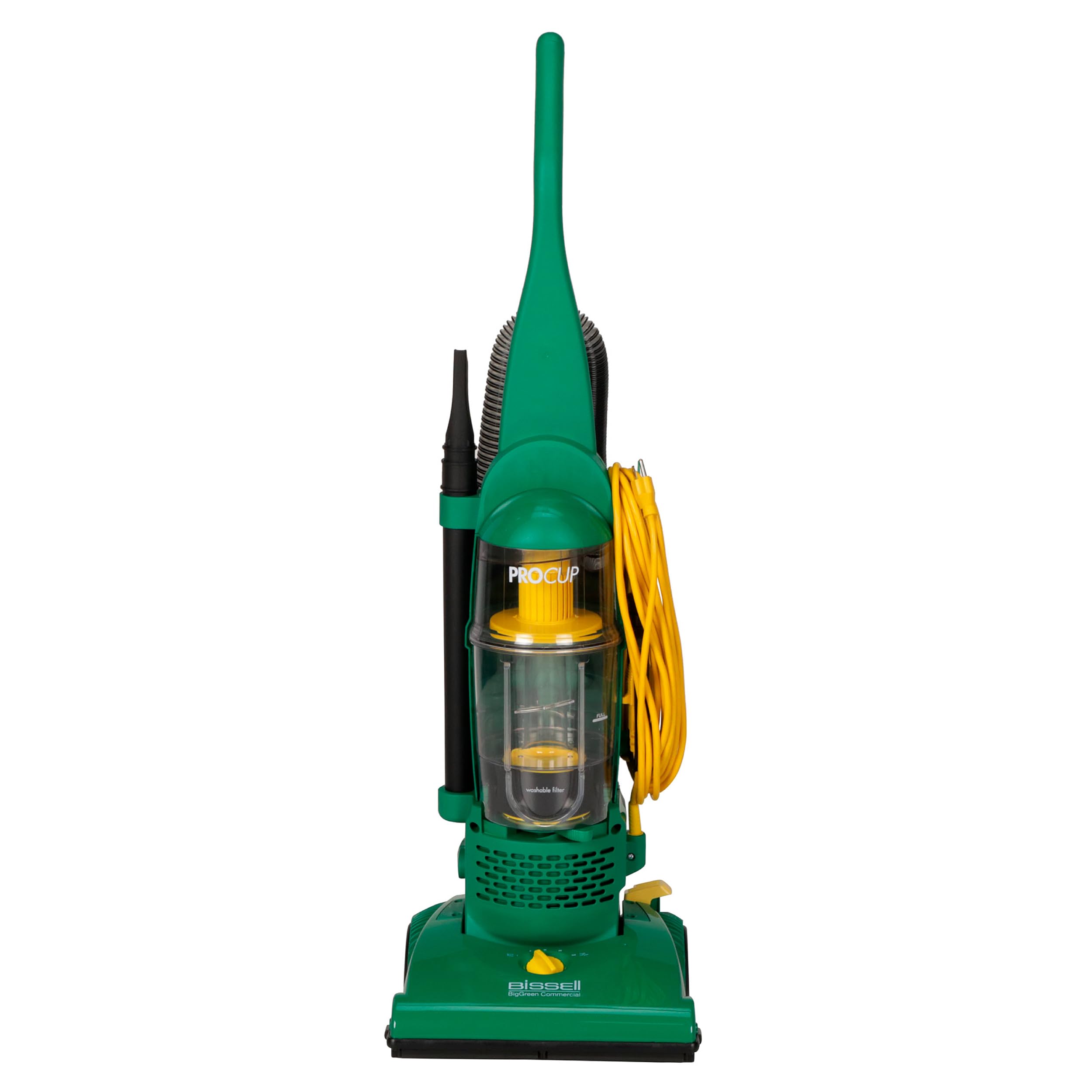
Pick this bagless upright for facilities that want to cut recurring bag costs without sacrificing a wide 13.5-inch cleaning path.
Pros
- Bagless dirt container eliminates ongoing bag purchases
- Washable filtration system reduces long-term maintenance cost
- Cord clamp design allows quick 30-foot cord replacement
Cons
- On/off switch reliability has been questioned in some reviews
- Bagless emptying is messier mid-shift than a bag swap
- Rated lower on durability than some bagged alternatives
Offices and janitorial teams trying to control consumable costs benefit from skipping bags entirely. The washable filter cuts down on ongoing filter purchases too, which adds up across a fleet of machines.
Five height settings handle everything from low-pile carpet to bare floors. The tradeoff shows up in emptying: dumping a bagless cup mid-shift is dustier than swapping a sealed bag, and a portion of reviewers flag switch reliability after moderate use.
BISSELL BigGreen PowerForce BGU1451T
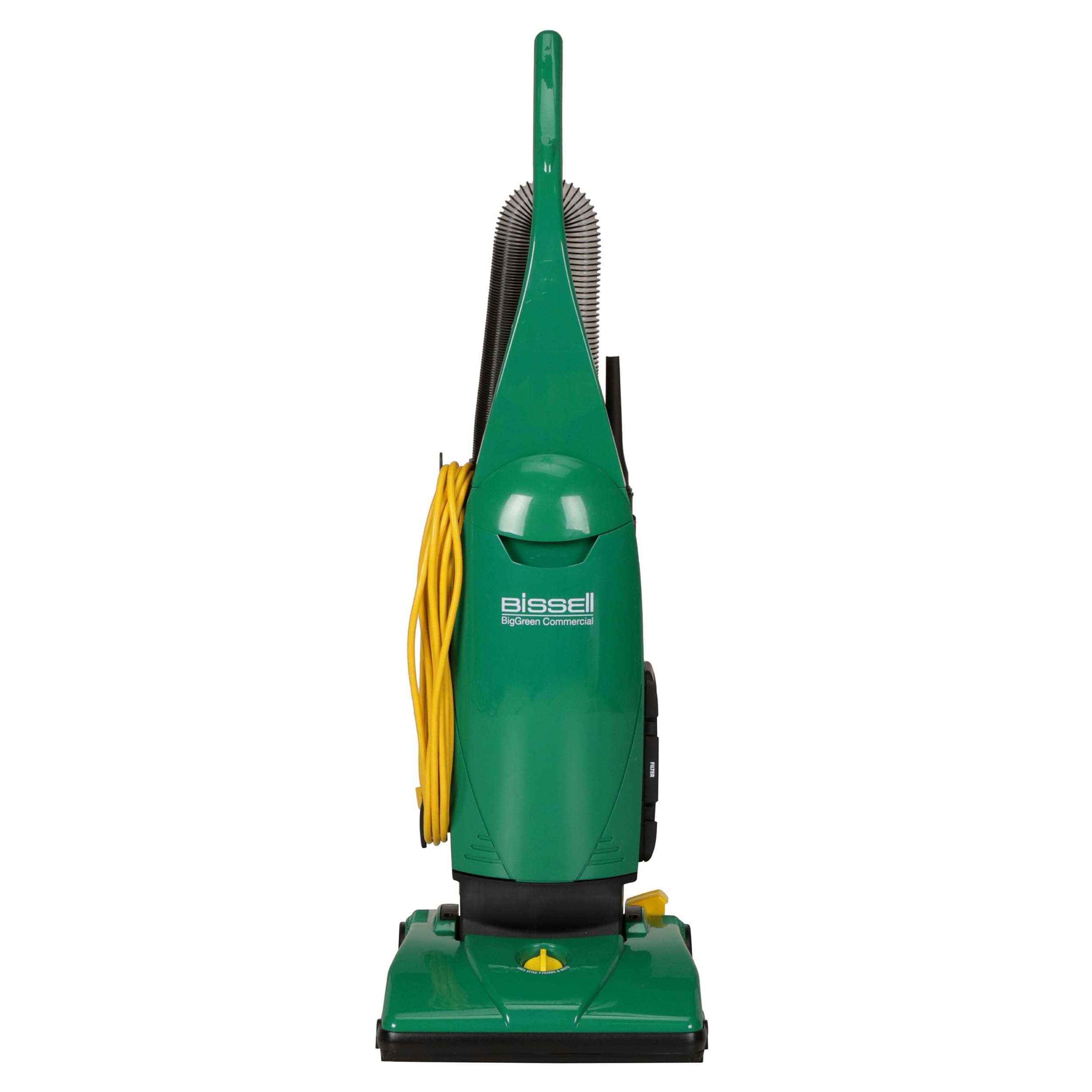
Choose this bagged upright for budget-limited operations that still want a long cord and a legitimate commercial label.
Pros
- Lightweight at 12 pounds for a bagged commercial upright
- 30-foot cord reduces outlet changes on large floors
- Three-stage filtration and on-board tool kit included
Cons
- Lower rated capacity and durability than pricier competitors
- Assembly instructions are frequently criticized as unclear
- Motor amperage is modest for heavier commercial soil loads
Property managers and retail businesses on tighter equipment budgets use this as an entry point into bagged commercial vacuums. It hits the specific combination of lightweight, bagged, and long-corded that is surprisingly rare at this price tier.
Reviewers who switched from bagless machines appreciate not dumping a dusty canister, and the on-board crevice tool and dusting brush add versatility. Expect a more basic build than the Sanitaire or Hoover uprights in this lineup, with a few complaints about long-term component wear.
Windsor Sensor S15

Go with this upright for hospitality and property-management operations that prioritize repairability and hospital-grade filtration over a low sticker price.
Pros
- S-class filtration traps 99.6% of particles at 0.3 microns
- Wide cleaning path suited to covering large areas quickly
- Simple, readily available replacement parts
Cons
- Higher price point than most bagged commercial uprights
- Limited to carpet cleaning, no hard-floor or wet capability
- Fewer user reviews available than mainstream brands
Hotel housekeeping teams and property managers who have used Windsor Sensor machines for years point to the same advantage: parts are easy to find and repairs are quick, unlike vacuums that manufacturers stop supporting after a few years.
The 40-foot cord and wide brush path suit large carpeted areas that need fast coverage. This is a carpet-focused machine only; buildings with mixed flooring will need a second vacuum or an attachment-based canister for hard surfaces.
Buying Guide
Match the Vacuum Type to the Job
Upright vacuums cover large carpeted areas efficiently and suit daily janitorial routes in offices, schools, and hotels. Backpack vacuums trade some cleaning width for maneuverability on hard floors and around obstacles. Canister vacuums handle detail work, stairs, and upholstery. Wet/dry extractors are the only category equipped for liquids, construction debris, and heavy shop waste; never substitute a dry-only upright or canister for a job that involves spills or standing water.
Airflow and Suction Matter More Than Wattage Alone
Motor wattage indicates power draw, not cleaning performance. Airflow, measured in CFM (cubic feet per minute), and static suction (measured in inches of water lift) determine how well a machine lifts debris from carpet fibers or hard floors. A well-engineered lower-wattage motor can outperform a higher-wattage one with poor airflow design.
Filtration Type and HEPA Ratings
| Filtration Level | Typical Use Case |
|---|---|
| Basic bag or cloth filter | General dry debris, low dust sensitivity |
| HEPA filter | Offices, healthcare, allergy-sensitive environments |
| Certified HEPA with sealed system | Lead paint, drywall dust, regulated environments |
True HEPA filtration captures fine particles down to 0.3 microns at a high efficiency rate. Confirm whether a filter is certified HEPA or simply “HEPA-like,” since only certified systems meet regulatory dust standards for jobs like lead-safe renovation work.
Capacity, Bag Cost, and Maintenance
Bagged systems cost more over time in consumables but keep dust contained during disposal. Bagless systems save on bags but require more frequent, dustier emptying. Tank or bag capacity should match the job size: an 18-quart bag suits daily office runs, while a 21-gallon wet/dry tank suits large jobsite cleanups.
Cord Length, Noise, and Operator Comfort
Cord length between 30 and 48 feet reduces outlet changes and lost time. Noise levels below 70 dB matter in occupied buildings such as retail stores, schools, or medical offices; anything above 80 dB will draw complaints during business hours. Weight and harness design affect fatigue on long shifts, especially for backpack and shoulder-carried models.
Tool-Start and Automatic Features
Tool-start functions, which power the vacuum on automatically when connected to a sander or saw, matter for contractors doing renovation work. Automatic belt-protection features, like shutting off the motor when a brush roll jams, reduce mid-job downtime and repair costs.
Editor’s Choice
The Oreck Commercial XL earns the top spot for routine commercial floor care. Its 9-pound weight, long cord reach, and strong carpet agitation cover the most common daily need: fast, repeatable cleaning across multiple rooms without wearing out the operator.
For jobsite and shop cleanup, the Industrial Wet/Dry Vacuum JM773 stands apart as the only machine in this lineup built for genuine wet and dry recovery at scale. Its dual-motor airflow and 21-gallon tank handle debris volumes that dry-only vacuums cannot touch.
Facilities needing certified filtration for regulated dust, such as lead paint or heavy drywall sanding, should look to the Nilfisk Alto Aero 26 HEPA for its tool-start function and quieter operation.
Conclusion
Commercial vacuum shopping comes down to matching machine type to the mess. Daily carpet and hallway cleaning favors a lightweight bagged upright like the Oreck or Sanitaire. Hard-floor-heavy properties get more value from a backpack or canister with a long cord and blower function. Jobsites with spills, sawdust, or drywall dust need a true wet/dry extractor with real tank capacity, not a dry-only machine pressed into service it was not designed for.
Filtration quality, cord length, and noise level separate machines that look similar on a spec sheet. A vacuum rated for 500 hours of commercial motor life and tool-free maintenance will cost less to operate over several years than a cheaper unit that needs frequent belt or switch repairs. Match the capacity and filtration to the specific environment, and the equipment budget goes further.
FAQS
What is the difference between an industrial vacuum and a regular commercial vacuum? Industrial vacuums, particularly wet/dry extractors, handle liquids, construction debris, and heavy shop waste that standard commercial uprights or canisters are not built to process. Commercial vacuums focus on daily carpet and hard-floor maintenance in offices, hotels, and retail spaces.
Do commercial vacuums need HEPA filtration? HEPA filtration is not mandatory for every commercial setting, but it is important in healthcare facilities, schools, and any environment with regulated dust like lead paint or extensive drywall work. Certified HEPA filters capture particles down to 0.3 microns.
How long should a commercial vacuum motor last? Motor life varies by model and use intensity. Some commercial uprights are rated for around 500 hours of motor performance, while lighter-duty canister vacuums have been reported to run 8 to 10 years under regular commercial use before motor replacement is needed.
Can a bagged vacuum handle the same volume as a bagless one? Bag capacity and bagless container capacity vary by model, not by bag versus bagless design alone. Bagged systems keep dust contained during disposal, while bagless systems require more frequent emptying but save on consumable costs.
Is a backpack vacuum better than an upright for commercial cleaning? Backpack vacuums suit hard-floor-heavy properties and situations requiring long reach and maneuverability around furniture. Uprights cover large carpeted areas more efficiently in a single pass. The better choice depends on the flooring mix in the space being cleaned.
